
Ramsey Solutions surveyed more than 10,000 millionaires. The results run counter to almost everything people assume about how wealth actually gets built in America.
I work with pre-retirees and corporate executives navigating the real complexity of building and protecting wealth. When I looked at that study alongside the Federal Reserve’s own household wealth data, I saw the same patterns I see when families first come to work with me.
Here are the seven habits that show up over and over, and the one almost nobody talks about that may matter more than the rest.
1. They were first generation, almost all of them
The first thing that jumps out is the inheritance question.
Ramsey found that 79% of the millionaires in their study received no inheritance at all. Zero. They built it from their own earnings, their own savings, their own decisions made over decades. Only 3% inherited $1 million or more.
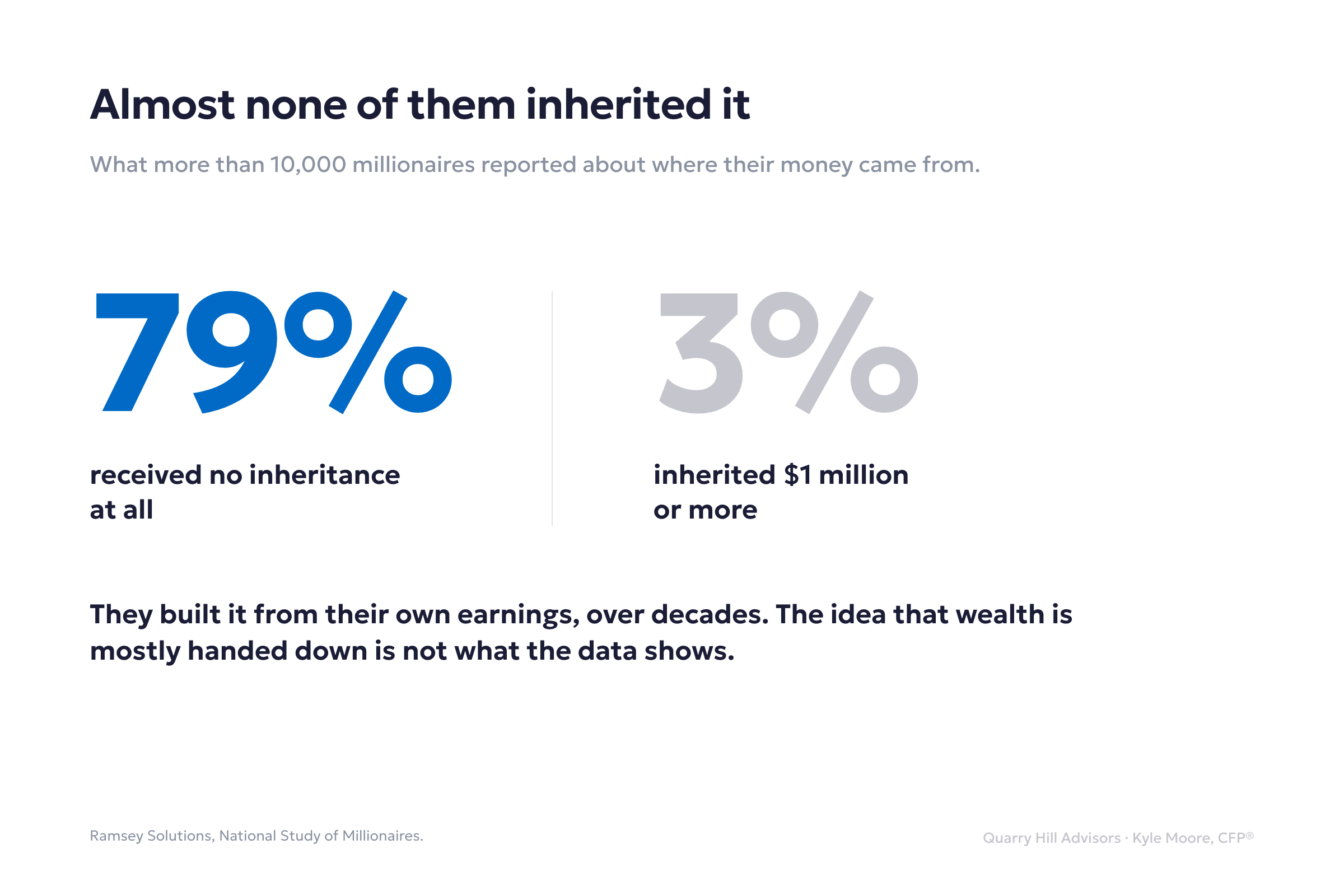
So the cultural narrative that wealth is mostly handed down is not supported by the data.
I know what some of you are thinking. Of course the study says that. But the Federal Reserve’s household wealth numbers tell the same story. Roughly 18% of US households now have at least $1 million in net worth when you count home equity and retirement accounts. That’s about one in five families. The vast majority of them are headed by someone in their late 50s or early 60s who spent thirty years making consistent decisions, not someone who got lucky with a windfall.
When families first come to work with me, one of the first things I want to understand is the story they are telling themselves about why wealth is or isn’t possible for them. The most common version I hear is some form of “I didn’t start with advantages, so I’m already behind.”
How your journey starts does not define how it ends. I have watched that play out too many times to dismiss it.
2. They ignored the prestigious school myth
The education piece is genuinely underappreciated.
The cultural assumption is that you need a prestigious private university, a powerful network, and elite credentials to have a real shot. The data does not support it.
Ramsey’s study found that teachers, engineers, and accountants ranked among the top professions for everyday millionaires. Not hedge fund managers. Not tech founders. Teachers. These are people who went to public universities, often borrowed to do it, and then worked in the field they studied.
The dangerous side of this is the debt. Total US household student loan debt now sits at roughly $1.8 trillion, according to the Education Data Initiative. College Board data for 2023-2024 shows the average bachelor’s recipient who borrowed left school with about $29,560 in loans. For graduate students the number climbs toward $100,000 in combined debt. Federal Reserve research estimated that when student loan payments resumed in 2023, it pulled roughly $80 billion a year out of consumer spending.
The pattern in the millionaire data is clean. Borrow in proportion to your earning potential, work in the field you studied, and don’t let education become a debt trap that follows you into your 40s.
That isn’t a rule anyone taught them. It is what common sense and good instincts pushed them toward.
3. They had a real savings rate, not a pretend one
This is the one that matters most mechanically.
The US personal savings rate as of mid-2026 sits around 3% of disposable income, per the Bureau of Economic Analysis. And Vanguard’s How America Saves 2026 shows that while the average 401(k) balance reached a record $167,970, the median participant sits at about $44,000.
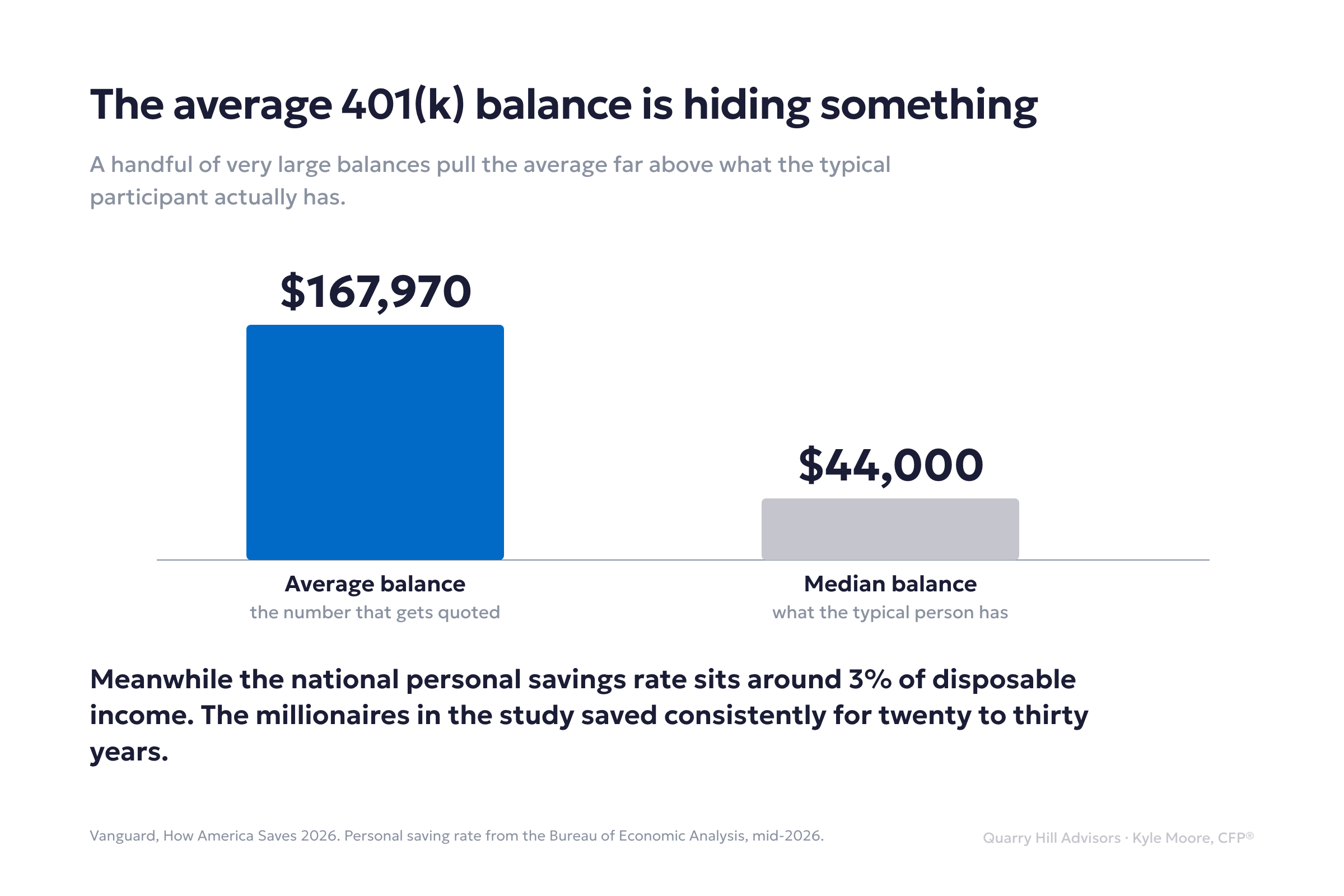
The average looks fine until you realize most people are nowhere near the average.
Now compare that with the millionaire research. These are people who consistently invested a significant share of their income over decades, maxing out retirement accounts and then investing beyond them. The Ramsey study found that long-term automatic contributions to an employer plan over 20 to 30 years is the most common path to seven figures.
Not stock tips. Not crypto. Not timing the market. Boring, relentless, automatic saving.
Here is the reframe I want you to sit with. That is how wealth gets built. It is not how wealth gets preserved.
A lot of the families I work with were excellent accumulators. They saved hard, contributed religiously, and got to $1.5 or $2 million or more. Then the challenge shifts completely, and the accumulation mindset that got them there becomes the thing standing between them and actually using the money.
If you are still accumulating and wondering whether your savings rate is in the right range, Fidelity’s benchmark of roughly ten times your salary by age 67 is a reasonable starting point. For someone earning $100,000 that is $1 million in retirement accounts. Against a median 401(k) balance of $44,000, most Americans are running a very significant deficit against that benchmark.
The millionaires in the study were not. They saved early, they saved consistently, and they never stopped.
4. They treated debt like fire
Debt is useful to look at because it is so concrete.
Ramsey found that roughly three quarters of everyday millionaires have never carried a credit card balance. They use cards. They take the points and the cash back. They pay in full every month, without exception.
Consider the environment they were navigating. US credit card debt is now over $1.2 trillion according to the Federal Reserve Bank of New York. The average cardholder carrying a balance is sitting on roughly $6,600 in revolving debt at interest rates near multi-decade highs. Bankrate’s 2026 emergency savings survey found that 29% of Americans have more credit card debt than emergency savings.
Almost one in three people owe more on their cards than they have saved for a crisis.
I use an analogy for this constantly. Leverage is like fire. Contained in the fire pit, it is a useful tool. A mortgage on a home that builds equity over thirty years is fire in the pit. Consumer debt at 20% plus on a rapidly depreciating car, or on last month’s dinners out, is fire that has left the pit. Once it is outside, it does real damage.
One client learned that the hard way through a margin call during the 2008 and 2009 stretch. That story has shaped how I think about debt for every person I have worked with since.
The millionaires in the research are not complicated about this. They pay off what they owe, they keep the fire contained, and the money they would have spent on interest goes to work in their portfolios instead. Over thirty years, that difference compounds in a way that is hard to overstate.
5. Their cars and houses did not eat them alive
The fifth habit is about the two biggest spending decisions most people make, and the data here is counterintuitive.
These are not people driving a new luxury vehicle every three years. The research shows the vast majority of millionaires drive a car for more than seven years. They treat it as reliable transportation, not a status signal.
Contrast that with what the Federal Reserve shows on housing. Homeowners average about $1.5 million of net worth. Renters average about $154,000. Home equity is one of the primary wealth-building vehicles for everyday millionaires.
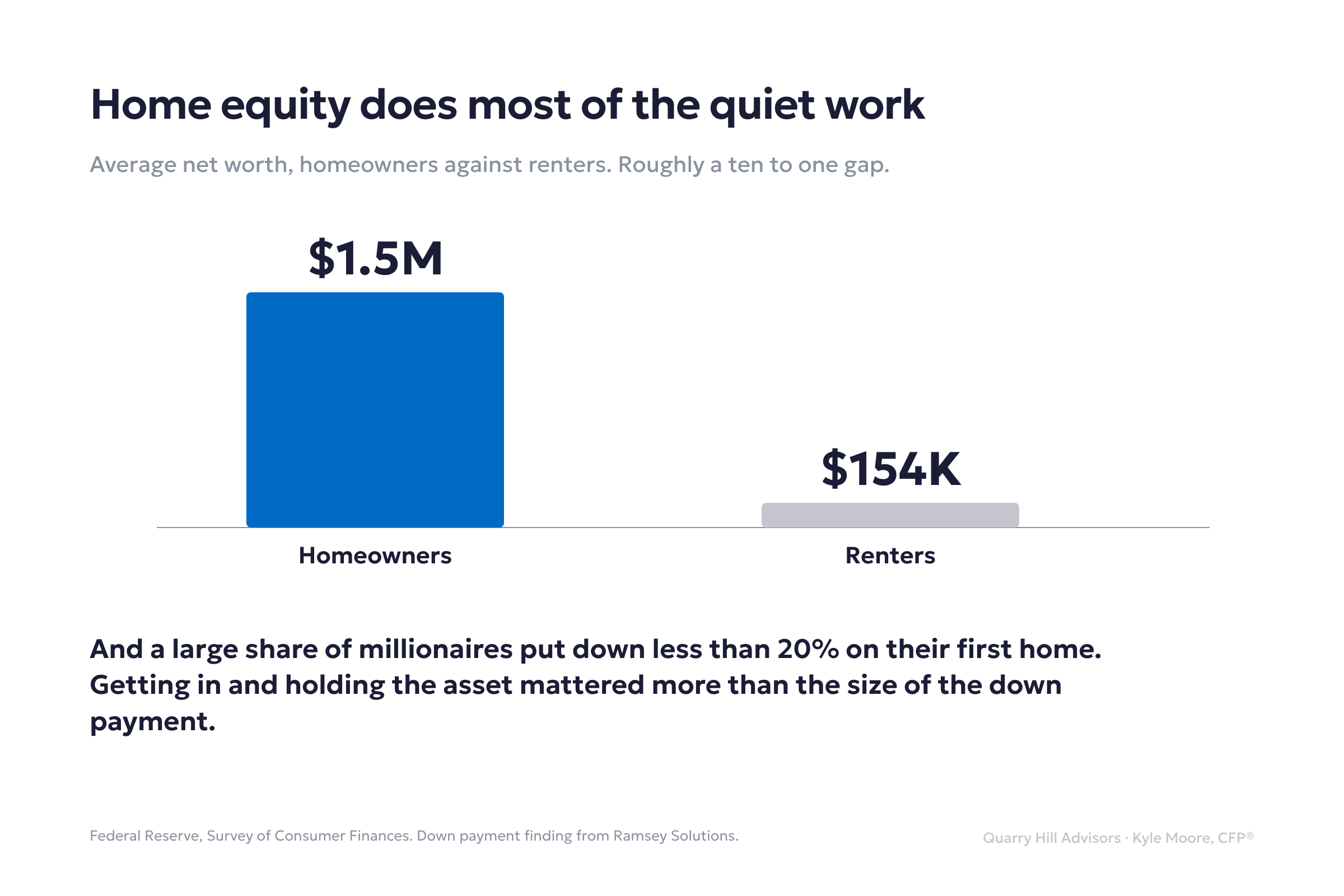
But the house can also become one of the most dangerous sources of financial stress when it is oversized relative to everything else in the plan. I see that regularly.
Here is a detail that surprises people: the standard 20% down payment is not what most millionaires actually did. A large share of them put down less than 20% on their first home. Which matches what I tell clients. Don’t let perfect be the enemy of good. If your income and cash flow support the purchase, get in, build the equity, and stay put. The thirty-year compounding effect of home equity is powerful, but only if you hold the asset long enough for it to work.
The deeper point is that both the car and the house are consumption decisions first. The millionaires in the study treated them that way. They bought reliable transportation and adequate shelter, and they directed what they saved by not over-consuming into investments.
A savings rate isn’t a number on a spreadsheet. It is visible in every purchase decision you make.
6. They got serious about money before 30
This is the behavioral habit that explains the compounding math behind everything else.
Ramsey’s data shows roughly 58% of their millionaires got serious about personal finance before age 30. UBS’s 2025 global wealth report found that younger millionaires, particularly millennials, started investing around age 25 on average, a full decade earlier than boomers, who typically started around 35.
That ten-year head start is not a small advantage. Put $500 a month into a broadly diversified equity portfolio starting at 25 rather than 35, and the difference at 65 is not 20% more. It can be roughly double. Compounding over long periods is genuinely hard to internalize until you have watched it happen in your own accounts.
But I don’t want this to read as discouraging if you are 40 or 50.
Even in the millionaire data, 20% didn’t figure it out until their 30s, 12% in their late 30s, and 7% didn’t get serious until their 40s.
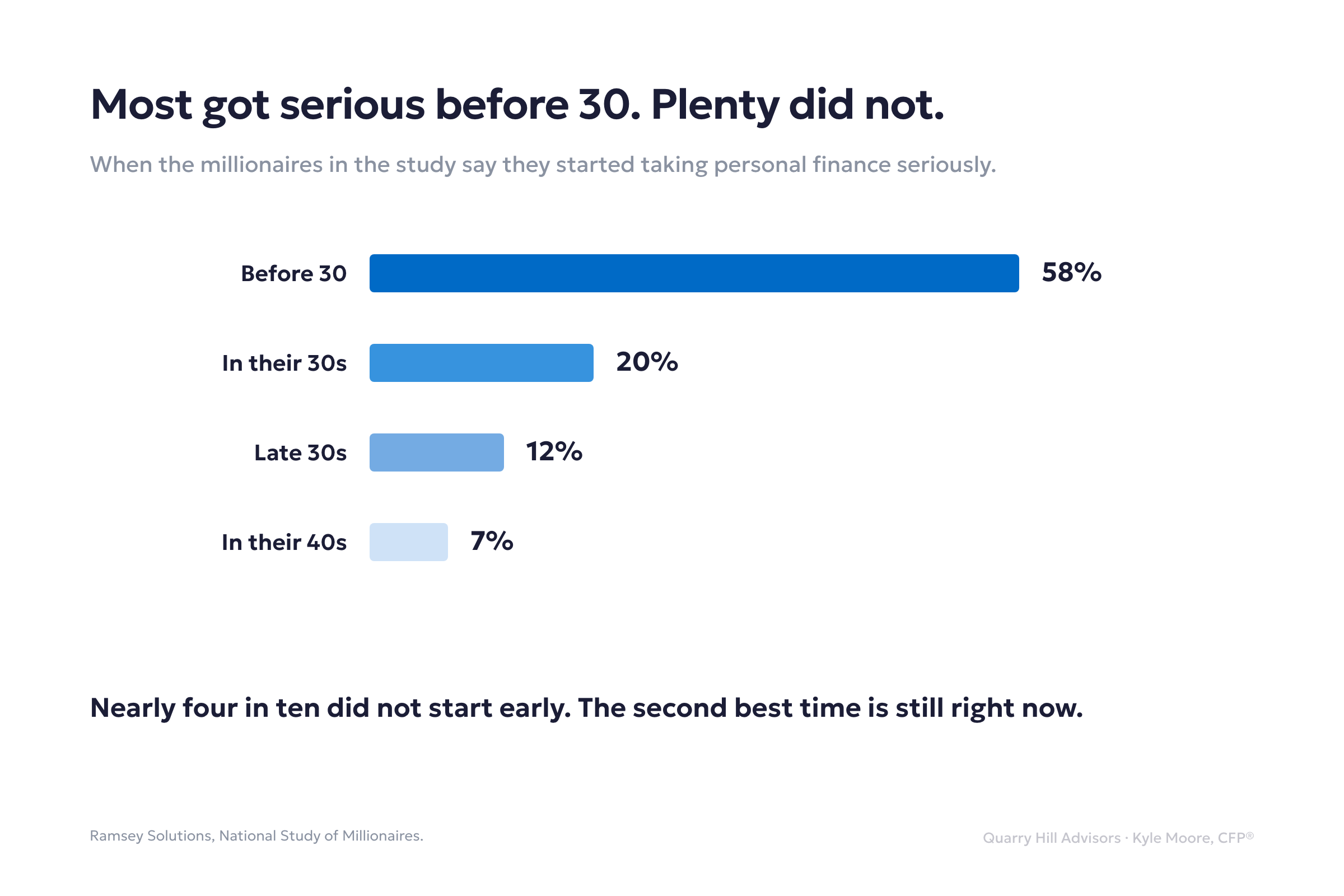
The second best time to start is right now. I have watched people in their mid-40s build very significant wealth by going from a 5% savings rate to 20% over a twenty-year window. The compounding is less dramatic. It is still powerful. What matters is that you start, and that you don’t stop.
7. They had a plan and they stuck to it
This is the quietest habit in the entire data set, and in some ways the most important.
The research shows that about three in four wealthy individuals work with a financial planner. The primary reason they sought one out was that their financial life had become complex. The equity compensation questions started. The tax optimization questions started. The estate questions started. And they recognized that the same temperament that made them good savers was not automatically the same thing as having a coordinated strategy across every variable at once.
Because investing is not really about intelligence. It is about temperament.
If you have the temperament to keep investing through downturns, to not overreact to who controls Congress or what is happening in the Middle East, you are likely to have a good investment experience over time. Markets have repeatedly fallen hard and then recovered faster than almost anyone predicted at the bottom. Very few people saw those recoveries coming while they were living through the drop.
Geopolitics, the economy, and the stock market are three distinct things. They are related. They are not the same thing.
The seven, in one place
First generation wealth built from scratch. Education used as an amplifier rather than a debt trap. A real savings rate maintained over decades. Debt treated with genuine discipline. Cars and houses consumed with restraint. Personal finance taken seriously early. And a coordinated plan that held up through complexity and volatility.
None of those require a windfall, an elite degree, or a hot stock. They require decisions repeated over a long time.
Let’s take a look at what you’ve built
If any of this reflects where you are, or where you are trying to get, and your financial life is getting complex enough that you want a second set of eyes on it, schedule a complimentary discovery call with our team at Quarry Hill Advisors.
Kyle Moore, CFP®, is a fee-only financial planner and the founder of Quarry Hill Advisors in Minnesota. He specializes in helping high-earning professionals and retirees navigate the financial decisions surrounding the transition to retirement.
This material is intended for educational purposes only. You should always consult a financial, tax, or legal professional familiar with your unique circumstances before making any financial decisions. Nothing contained in the material constitutes a recommendation for purchase or sale of any security, investment advisory services or tax advice.
Sources: Ramsey Solutions National Study of Millionaires; Federal Reserve Survey of Consumer Finances; Federal Reserve Bank of New York Household Debt and Credit Report; Bureau of Economic Analysis personal saving rate; Vanguard, How America Saves 2026; UBS Global Wealth Report 2025; Education Data Initiative; College Board, Trends in Student Aid 2024-2025; Bankrate 2026 Emergency Savings Survey.