
A lot of the executives I talk to in Minnesota eventually ask me some version of the same question: when should I take my deferred comp?
I understand why it comes out that way. It sounds like a scheduling question, the kind you answer by picking a date on a calendar.
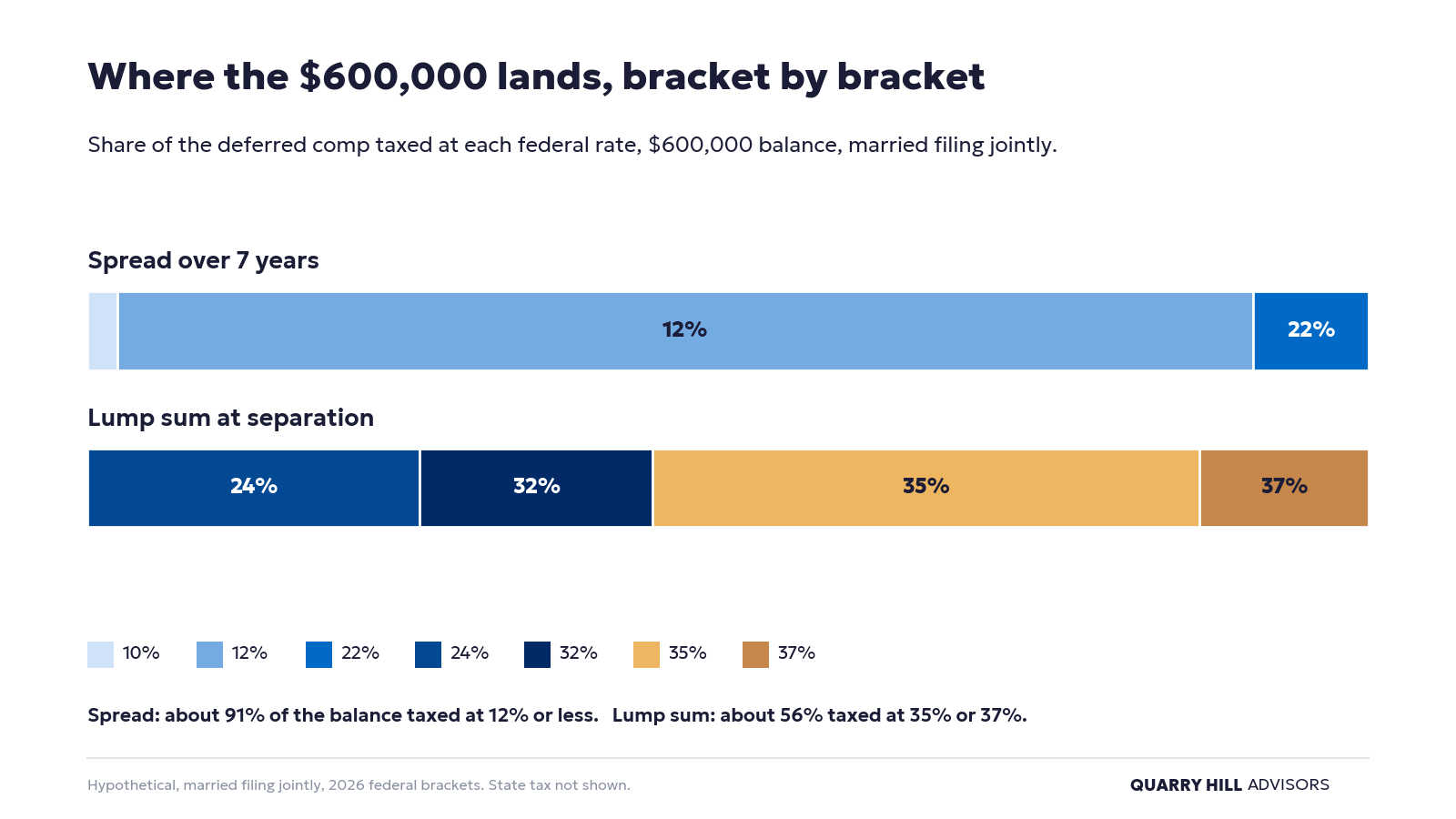
Taxes make it much bigger than that. The year your deferred comp pays out decides which bracket it lands in, and under the rules most plans follow, you lock that year in long before the money moves. Plan it well and most of the balance can be taxed at 12%. Leave the default in place and more than half of the same balance can be taxed at 35% or 37%.
What non-qualified deferred compensation actually is
Non-qualified deferred compensation is a portion of your salary or bonus that you push into a future year instead of taking it now. The income tax moves with it. You earn it this year, you don’t pay income tax on it this year, and you pay when you receive it.
When it works, it’s one of the most useful tools a high earner has. You’re moving income out of your peak earning years, where you might sit in the 35% or 37% federal bracket, into later years where, with some planning, you’re in the 22% or even the 12% range.
There’s a catch that a lot of executives underestimate. Your 401(k) is a protected retirement account; federal law requires those assets to be held in trust for you. Deferred comp has no such protection. It’s an unsecured promise from your employer to pay you later, and the money typically stays on the company’s balance sheet. If the company fails, you stand in line with its other general creditors.
Enron is the case most planners point to. In the weeks before its December 2001 bankruptcy filing, a group of participants took more than $53 million out of Enron’s deferred comp plans. About $435 million still in the accounts was frozen when the company filed, and the people it belonged to were left as unsecured creditors. Section 409A of the tax code was Congress’s response, enacted in 2004 to put real structure around when and how deferred comp can be paid.
So treat a deferred comp balance as an IOU. It’s worth what the company that issued it is worth.
Your distribution decision is a tax decision
Deferred comp is taxed as ordinary income in the year you receive it. That sounds simple until you look at everything else that might arrive in the same year.
Say you’ve retired and you’re collecting Social Security, a pension, some IRA withdrawals and a deferred comp payment, all in one calendar year. Those dollars stack on top of each other, and the deferred comp fills whatever bracket space the rest of your income left behind.
So the goal in almost every case is to land deferred comp dollars in a lower-income year. For most executives that window is the gap between when you stop working and when Social Security and required minimum distributions start. That gap is where the real planning happens.
The 409A rules that box you in
Most executives assume they’ll work out the timing as retirement gets closer. They’re 55, they have a $400,000 balance, and it feels like there’s plenty of time.
There usually isn’t. Your deferral election, meaning when you told the plan to pay you and in what form, generally had to be made before the start of the year in which you earned the money. Once it’s made, it’s irrevocable. A change in your circumstances doesn’t reopen it.
There is a way to push a payout later, and the rules are strict. The new election has to be made at least 12 months before the originally scheduled payment date, and the new payment date has to be at least five years after the original one.
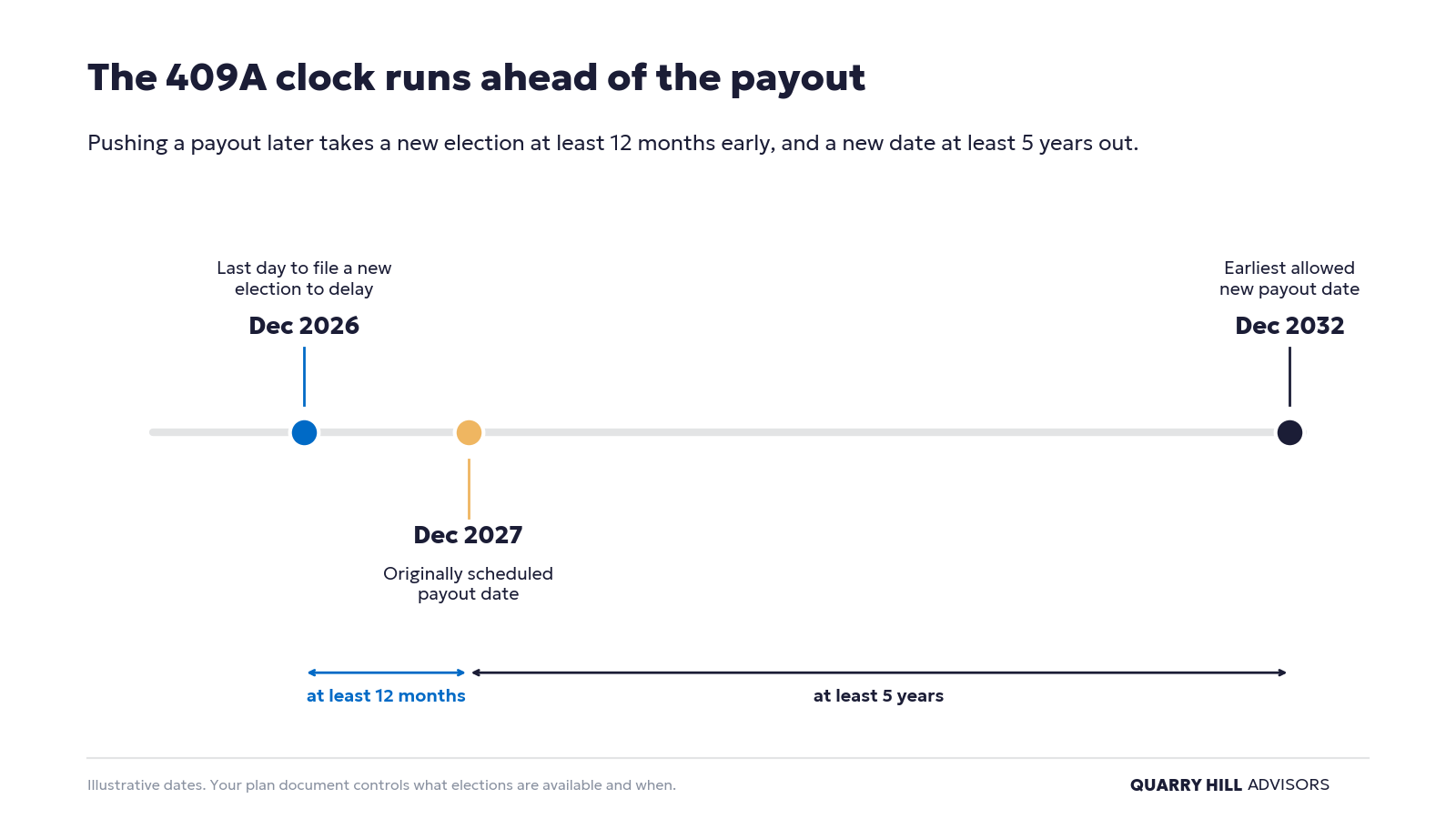
Here’s how that plays out with real dates. If your plan is set to pay you in December 2027 and you want to delay it, you have to act no later than December 2026, and the earliest new payout is December 2032. Miss that window and you take the money in 2027, whether it suits your tax picture or not. If you’re reading this in the fall of 2026 with a payout scheduled for late 2027, that deadline is close.
The rules only run in one direction. You can delay a payout if you plan far enough ahead, but you generally can’t pull one forward.
That’s why I start the deferred comp conversation three to five years before someone plans to leave, well ahead of the retirement conversation itself.
The default payout at separation
Of all the deferred comp mistakes I see, this one is the most painful because it’s so predictable.
A lot of plans default to paying out when you leave the company, and unless you specifically elected otherwise, that default is often a lump sum. So an executive retires with a $500,000 balance and the plan pays all of it in the year they separate. That same year they’re earning a final salary through their last day, possibly severance, and whatever else is already on their income picture. The $500,000 stacks on top and runs through the top brackets in what is already their highest-income year.
That tax bill came from a default election made years earlier that no one went back and changed.
What the timing difference looks like in dollars
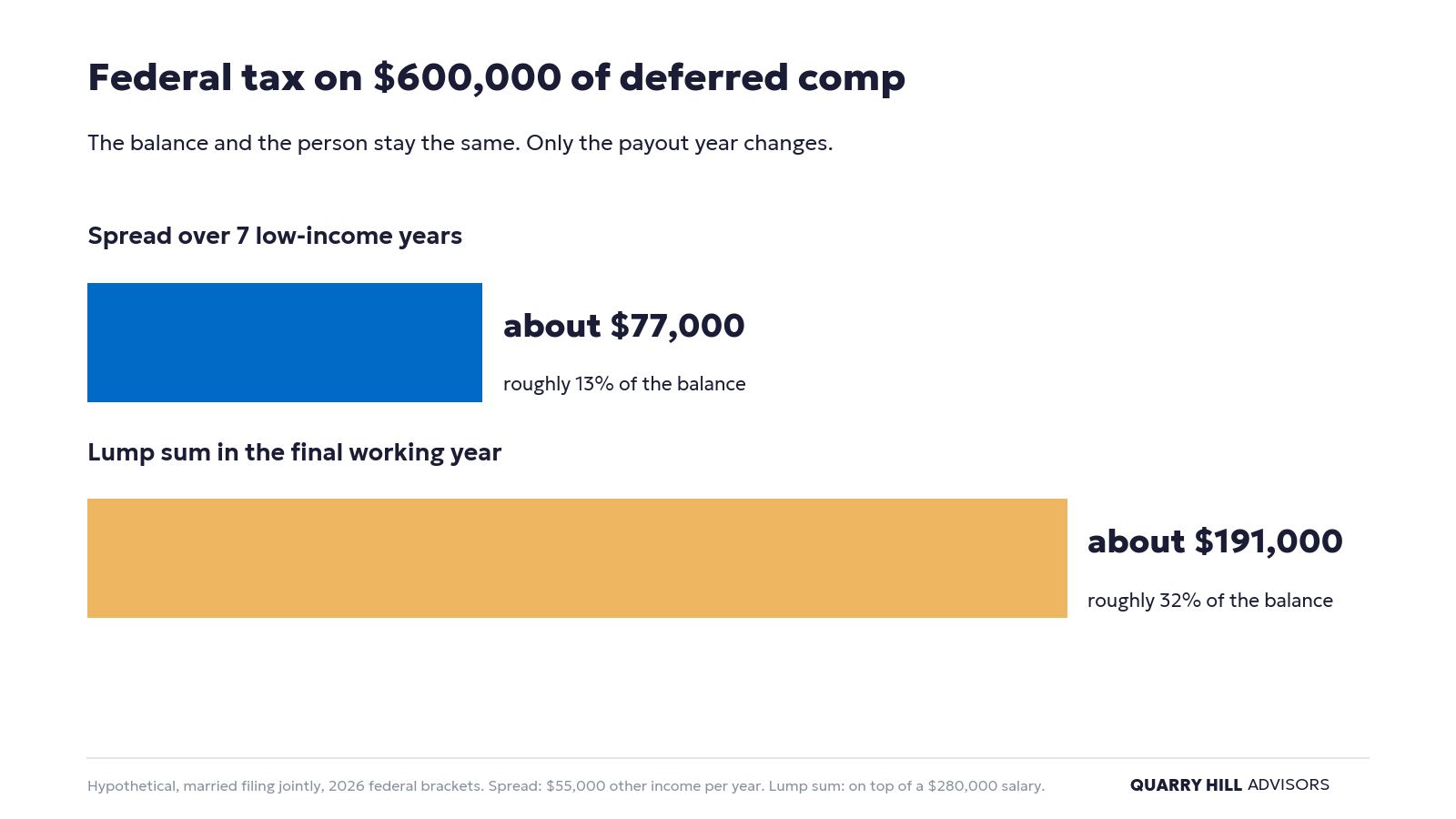
Take a hypothetical executive, married filing jointly, with $600,000 in deferred comp. They retire and delay Social Security to 70. In the years between retirement and Social Security, their other income is modest: about $55,000 a year from a small pension or IRA withdrawals.
If they spread the deferred comp evenly over seven years, about $85,700 a year, nearly all of it lands in the 10% and 12% brackets, with a small slice in 22%. Using 2026 federal brackets and the standard deduction, the federal tax on the deferred comp comes to roughly $77,000, about 13% of the balance. Their overall effective federal rate in those years is a little under 10%.
Now run the same person where they leave the election alone. The plan pays the $600,000 as a lump sum in their final working year, on top of a $280,000 salary. The deferred comp starts in the 24% bracket, and about $335,000 of it is taxed at 35% or 37%. The federal tax on the deferred comp alone comes to roughly $191,000, about 32% of the balance.
That’s a difference of about $114,000 on the same money for the same person, decided entirely by which year the dollars show up in the taxable income column. In a state with graduated rates, like Minnesota, state income tax widens the gap further.
What proactive deferred comp planning looks like
Every fall I run a tax projection for clients with deferred comp balances. We map the distribution schedule against Social Security timing, projected RMDs, pension income and a working spouse’s income if there is one. The point is to see the income picture year by year in advance, find the low-income windows, and make sure the deferred comp lands in them on purpose.
The timing matters because any change to your schedule requires a subsequent deferral election made at least 12 months before the original payment date. Once that window closes, you take the money on the original schedule. I’ve watched executives who were otherwise very well prepared for retirement create a six-figure tax bill in their first year out, because the projections weren’t run until it was too late to change the election.
The other thing worth revisiting regularly is the health of the company. Your deferred comp is an unsecured IOU for the entire time it sits in the plan, so each review should weigh the employer’s risk alongside the tax picture. The two belong in the same conversation.
You usually get one real shot at this. The decisions you make years before you retire go a long way toward deciding what you actually get to keep.
Frequently asked questions
How is deferred compensation taxed when it’s paid out?
Non-qualified deferred compensation is taxed as ordinary income in the year you receive it, at the same federal rates as wages. It stacks on top of everything else you earn that year, so the same payment can be taxed very differently depending on what other income lands alongside it.
Can I change my deferred comp distribution election?
Usually only to delay it. Under Section 409A, a change generally has to be made at least 12 months before the original payment date and has to push the payment at least five years later. You generally can’t accelerate a scheduled payout. Your plan document sets which options you have.
What happens to my deferred comp when I leave my company?
Many plans pay out at separation from service, and if you didn’t elect otherwise, that payout is often a lump sum in the year you leave. Because that year usually includes a final salary and sometimes severance, a lump sum can push much of the balance into the top federal brackets.
Is deferred comp protected if my company goes bankrupt?
No. Unlike a 401(k), non-qualified deferred comp is an unsecured promise to pay. If the employer goes bankrupt, participants generally become unsecured creditors and may recover only part of their balance.
Quarry Hill Advisors is a Minnesota based Investment Advisory Firm registered with the Securities and Exchange Commission (SEC). Registration of an investment advisor does not imply a certain level of skill or training.