
You earn $250,000 or more per year. You have spent decades paying into Social Security. Now retirement is in view and you are staring at three numbers: 62, 67, and 70.
Your coworker says take it early because you never know. Your accountant says delay to 70. Online calculators give you a third answer. And part of you wonders whether Social Security even matters when you have already saved $2 to $4 million on your own.
It matters. But the claiming decision at your income level is fundamentally different from the advice built for the general population. There are three factors that change the math, and most high earners never work through all three before making this decision.
Factor 1: The Replacement Rate Illusion
For someone earning $50,000 per year, Social Security replaces roughly 40% of pre-retirement income. At that level, maximizing the benefit by delaying to 70 makes complete sense. Social Security is a large piece of the retirement income puzzle.
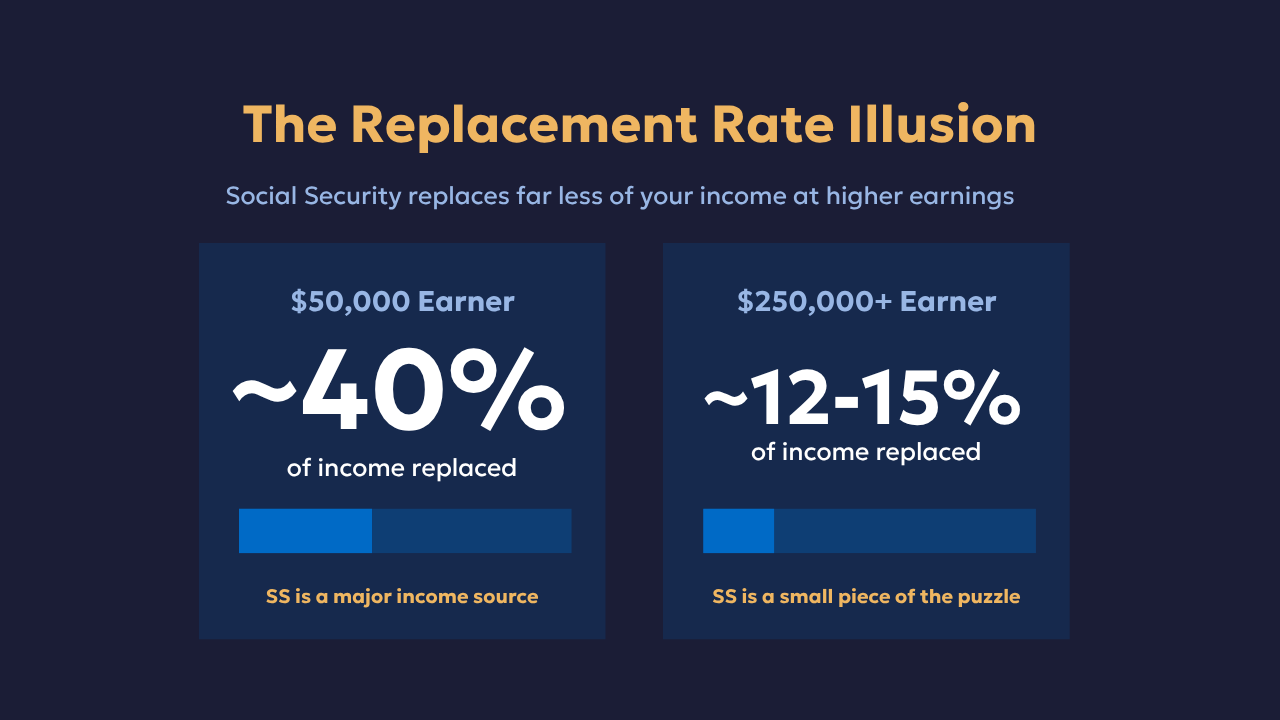
For someone earning $250,000 or more, Social Security replaces roughly 12 to 15% of income. That single difference changes the entire framework.
To put real numbers on it, in 2026 the maximum Social Security benefit at age 62 is about $2,969 per month, or $35,600 per year. At full retirement age of 67, the maximum rises to about $4,152 per month, or $49,800 per year. At age 70, it reaches $5,181 per month, or $62,200 per year.
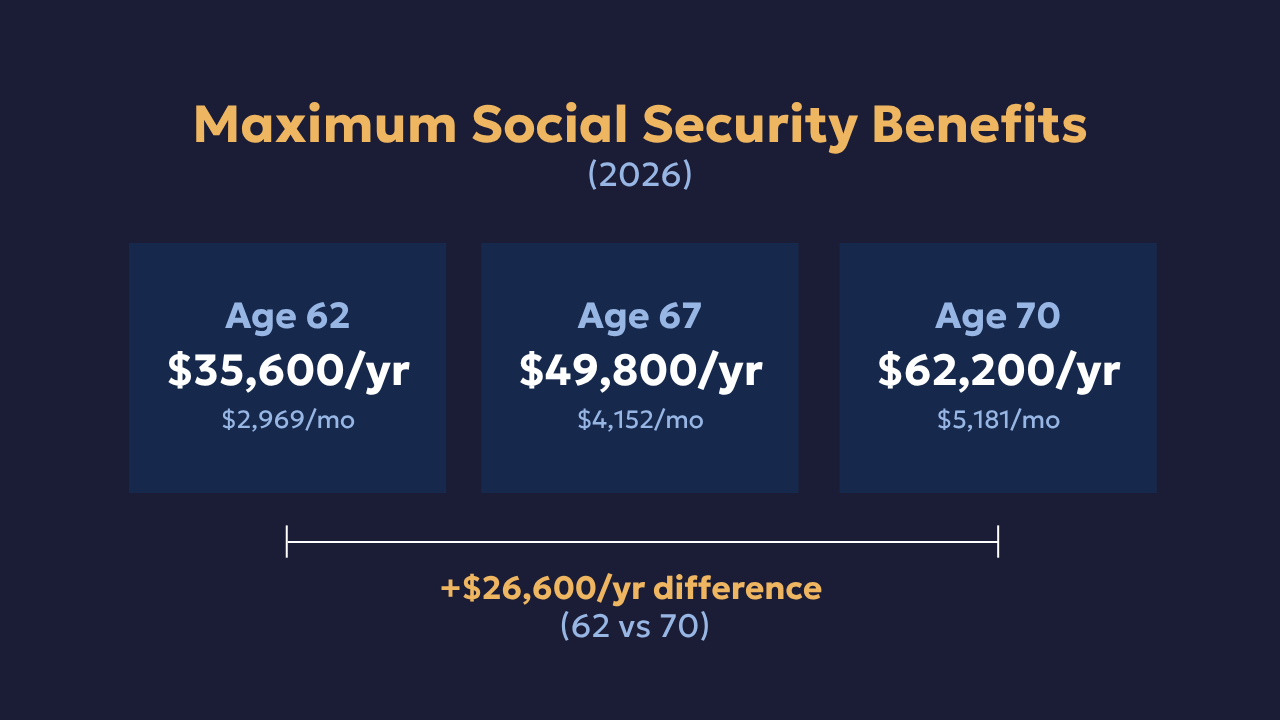
The gap between claiming at 62 versus waiting until 70 is roughly $26,600 per year. That is meaningful. But those monthly figures only tell part of the story. Claim at 62 and you collect eight years of payments before the person who waited until 70 receives their first check. That adds up to roughly $284,800 in cumulative benefits collected before the delayed claimer sees a dime. The break-even point, where the higher monthly benefit at 70 makes up for those eight missed years, typically falls around age 82 to 83.
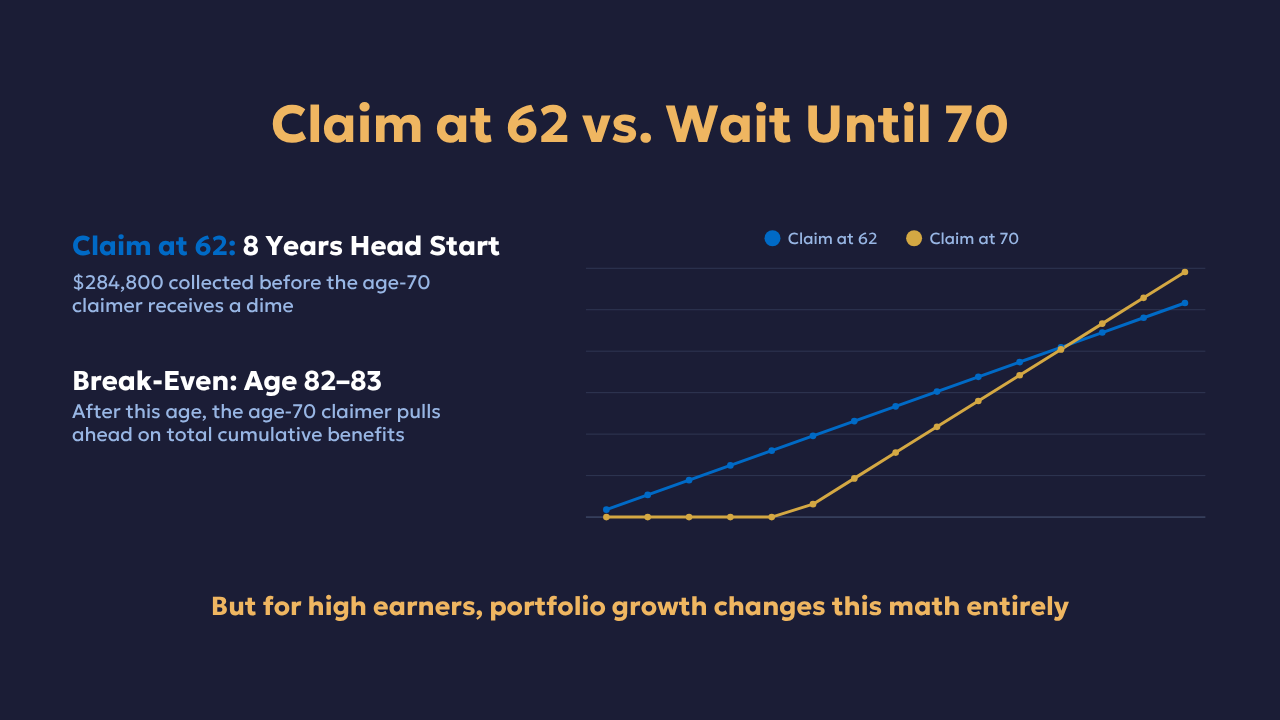
Here is where the replacement rate illusion comes in for high earners. You are not simply choosing between Social Security at 62 or Social Security at 70. You are choosing between Social Security at 62 plus what your portfolio earns on money you did not have to withdraw for eight years, versus Social Security at 70 plus eight additional years of portfolio drawdown. When you have $2 to $4 million in investable assets, that portfolio dimension can significantly shift the break-even analysis.
The replacement rate illusion leads high earners to frame this as a question of maximizing a monthly check. The more accurate frame is maximizing total household wealth.
Factor 2: The Earnings Test
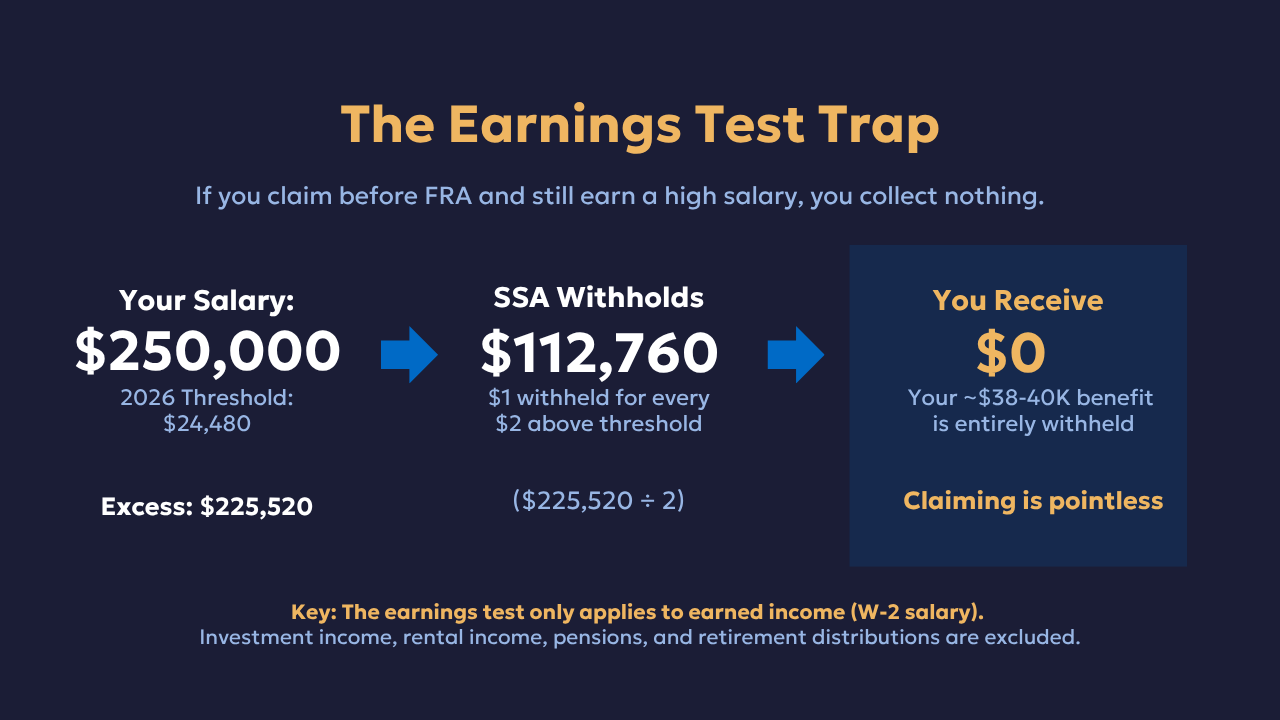
If you claim Social Security before your full retirement age while still working, the SSA reduces your benefit. In 2026, for every $2 you earn above $24,480, the SSA withholds $1 in benefits.
At $250,000 in earnings, you exceed that threshold by $225,520. That means $112,760 in withheld benefits, which is more than your entire annual Social Security payment. You would collect nothing.
The withheld amounts are not permanently lost. The SSA recalculates your benefit at full retirement age to credit the months that were withheld. But in practical terms, filing early while earning a high salary adds complexity and delivers no real benefit.
One important nuance: the earnings test only applies to earned W-2 income. Investment income, rental income, pension payments, and retirement account distributions do not count. The moment you stop receiving a W-2 salary, the calculation changes entirely.
For high earners, the first question is not 62 or 70. It is when you are actually going to stop working. That date determines when the earnings test no longer applies, and that is when the real Social Security analysis begins.
Factor 3: The Coordination Problem
Social Security does not exist in a vacuum. For households with $2 to $4 million saved, the claiming decision interacts with at least three other major financial variables: your Roth conversion strategy, your future Required Minimum Distributions, and your spousal survivor benefit.
Roth Conversions
The window between retirement and age 73, when RMDs begin, is the prime opportunity to convert traditional IRA money to Roth at lower tax rates. Every dollar of Social Security income added during that window raises your taxable income and shrinks the room available for conversions.
Claim Social Security at 62 or 63 while also running Roth conversions, and those two income streams stack on top of each other. You might move from the 22% bracket into the 24% or 32% bracket. A conversion that would have cost 22 cents on the dollar now costs 32 cents. On $500,000 in conversions, that bracket shift costs an additional $50,000 in taxes.
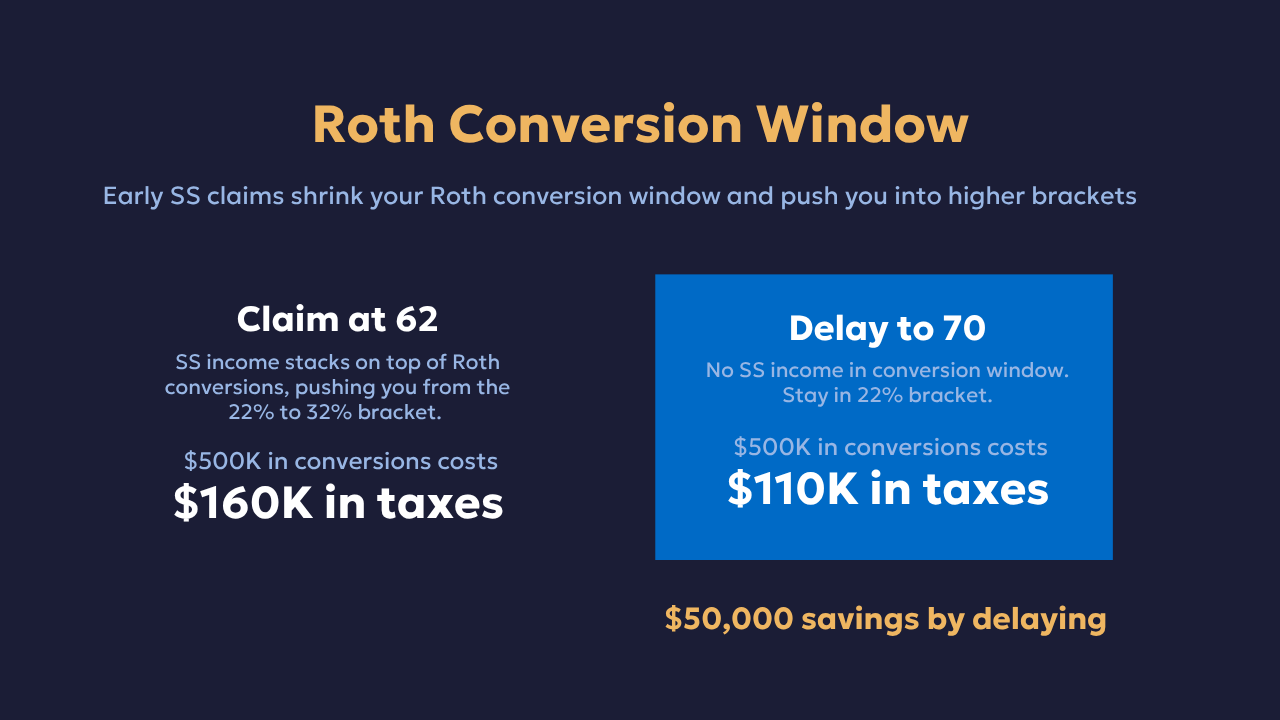
For some high earners, delaying Social Security to 70 is not primarily about maximizing the monthly check. It is about preserving the Roth conversion window and moving more money into tax-free accounts during those eight years.
Spousal Survivor Benefit
When the higher-earning spouse passes away, the surviving spouse keeps the larger of the two Social Security benefits and loses their own. If the higher earner claimed at 62 and locked in a reduced benefit, the survivor benefit is permanently reduced as well.
Delaying to 70 essentially purchases a larger, inflation-adjusted income stream for the surviving spouse, one that lasts their entire remaining lifetime.
Case Study: Marcus and Elena
Marcus is a senior VP earning $310,000 who wants to retire within the year. Elena recently left her marketing director role where she had been earning $180,000. Together they have $3.4 million saved: $2.1 million in traditional 401(k) and IRA accounts, $600,000 in Roth, and $700,000 in taxable brokerage. They want to spend $165,000 per year after taxes in retirement. Both are 63.
We modeled four scenarios.
Scenario 1: Both claim at 62: Combined Social Security of roughly $58,000 per year starting immediately. Lower portfolio withdrawals in early retirement, but Social Security income stacking on top of Roth conversions would cost approximately $140,000 in Roth conversion efficiency over seven years. Elena's survivor benefit would also be permanently reduced by about $13,000 per year.
Scenario 2: Both delay to 70: Combined Social Security of roughly $96,000 per year starting at 70. The Roth conversion window stays open from 63 to 70, allowing approximately $600,000 in conversions at favorable rates. But the portfolio must fund the full $165,000 in spending for seven years with no Social Security offset, creating a 6.2% early withdrawal rate.
Scenario 3: Elena claims at 65, Marcus delays to 70: Elena's benefit of $42,000 per year starting at 65 reduces portfolio pressure during the middle years. Marcus delays to lock in the maximum benefit and the highest possible survivor benefit. The Roth conversion window stays fully open from 63 to 65 before narrowing slightly.
Scenario 4: Elena claims at 67, Marcus delays to 70: Elena waits for her full unreduced benefit. The Roth conversion window stays fully open for four years and partially open for three more.
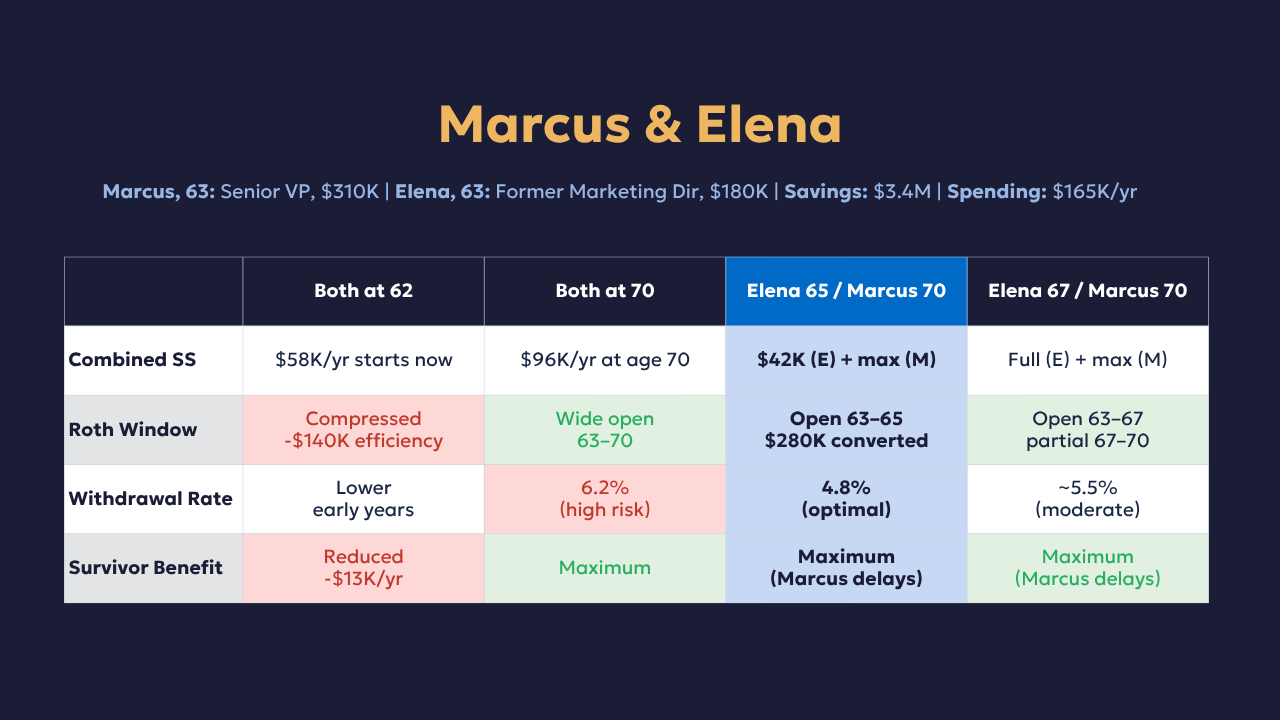
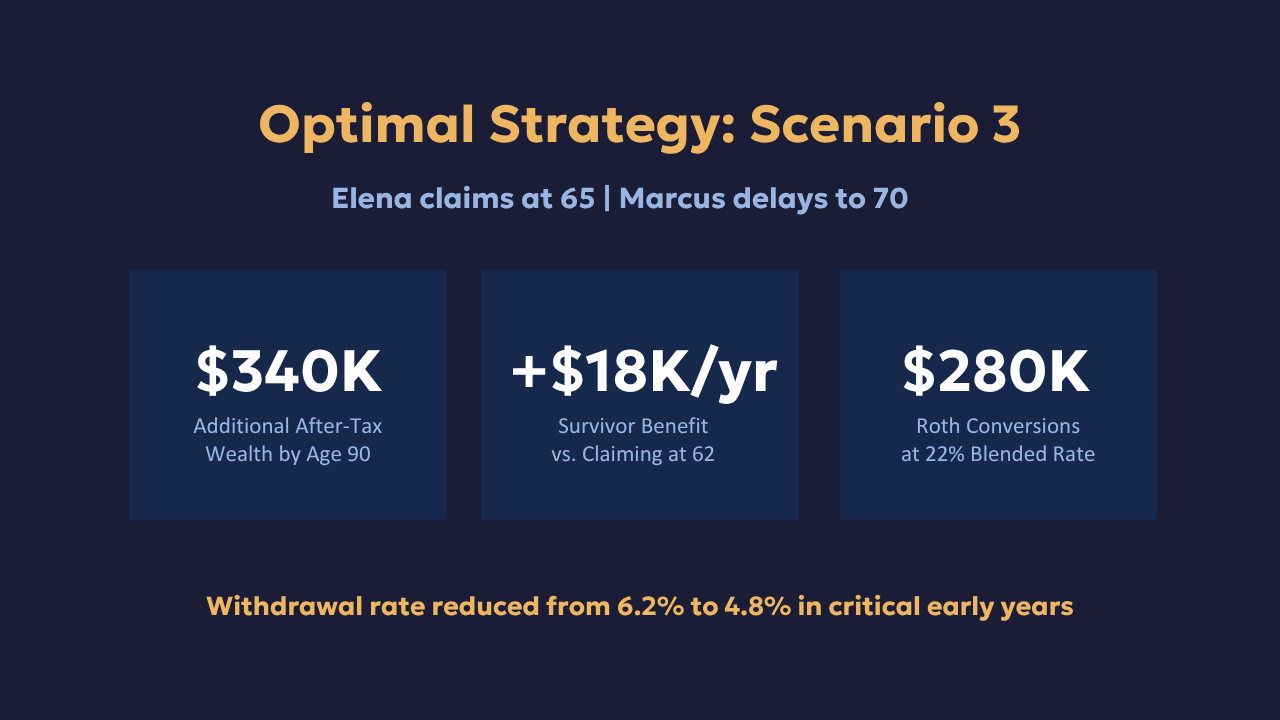
After running projections through age 95, Scenario 3 came out ahead. Elena claiming at 65 drops the portfolio withdrawal rate in those critical early years from 6.2% to 4.8%. Marcus delaying to 70 secures a survivor benefit worth approximately $18,000 per year more than if he had claimed at 62. And the Roth conversion window from 63 to 65 is enough to move $280,000 from traditional to Roth at a blended rate of 22%.
The total lifetime benefit of this coordinated strategy compared to both claiming at 62: approximately $340,000 in additional after-tax wealth by age 90, plus significantly stronger protection for whichever spouse survives.
Putting It Together
For high earners, three things shape this decision. Your replacement rate is relatively low, which means the goal is optimizing total household wealth rather than maximizing a monthly check. The earnings test makes claiming before you stop working almost pointless. And the interaction between Social Security timing, Roth conversions, and spousal survivor benefits often carries more financial weight than the Social Security benefit itself.
The high earners who navigate this well share one thing in common: they stop treating Social Security as an isolated decision and start treating it as one variable in a coordinated system.
Social Security timing is one piece, but it has to work alongside your tax strategy, your Roth conversions, your withdrawal sequencing, and your estate plan. If you want to see how these pieces fit together for your specific situation, click the first link in the description to learn more about our Bedrock Planning Process and consider scheduling a complimentary Retirement Readiness Review.
Ready to find out if we're the right fit for your financial planning needs? Schedule a complimentary discovery meeting where we'll provide a real assessment of how we can help your specific financial situation.
-A note from Kyle Moore, CFP®
This material is intended for educational purposes only. You should always consult a financial, tax, or legal professional familiar with your unique circumstances before making any financial decisions. Nothing contained in the material constitutes a recommendation for purchase or sale of any security, investment advisory services or tax advice. The information and opinions expressed in the linked articles are from third parties, and while they are deemed reliable, we cannot guarantee their accuracy.