
Nearly one in five Americans 65 and older is working or looking for work. The Bureau of Labor Statistics put the figure at 19.1% in 2025, up from 12.9% in 2000. Some of those people simply like working. A lot of them didn’t plan on it.
When AARP asked retirees who had gone back to work why they did it, 48% said they needed the money or were worried about their finances. Those people had a plan of some kind, and something in it didn’t hold.
I’m a financial planner in Minnesota, and most of the people I work with are pre-retirees and corporate executives asking some version of the same two questions: do I have enough, and will the plan hold up once I’m living on it? This is what I see derail retirement plans, a hypothetical example with real numbers, and a framework for building a plan you won’t second-guess every time the market moves.
The retirement income gap starts with Social Security
After the 2.8% cost-of-living adjustment, the Social Security Administration estimates the average retired worker’s benefit at about $2,071 a month in 2026. For most households that covers a fraction of what they actually spend. The rest has to come from savings, and if the plan doesn’t account for that gap honestly, retirement ends early and the person is back at work.
The savings underneath that gap are thin for a lot of people. An AARP survey found that one in five Americans over 50 has no retirement savings at all. EBRI’s 2026 Retirement Confidence Survey found worker confidence fell to 61%, down from 67% a year earlier, with inflation, debt, housing and health care costs near the top of the list of worries. Those worries are a reasonable response to real math.
A $2.2 million portfolio and the income it actually produces
When families first come to us, they’ve usually been focused on one number: the total portfolio balance. They haven’t mapped what that number produces in income, and those are two very different things.
Take a hypothetical couple, John and Mary. John is 57 and Mary is 55. They have $2 million in a 401(k), all pre-tax, and another $200,000 in a taxable brokerage account. On paper, $2.2 million looks very good.
Here’s what the paper version leaves out. Every dollar in that 401(k) is pre-tax, so the IRS has a claim on it before John and Mary spend any of it. When they say they want $10,000 a month in retirement, they mean after taxes, which means the gross withdrawal has to be meaningfully higher. Required minimum distributions also start at 75 for anyone born in 1960 or later, which includes both of them, so even in years they don’t want the money, the IRS will make them take it. A 401(k) is a good place to build wealth. Drawing it down efficiently takes its own plan.
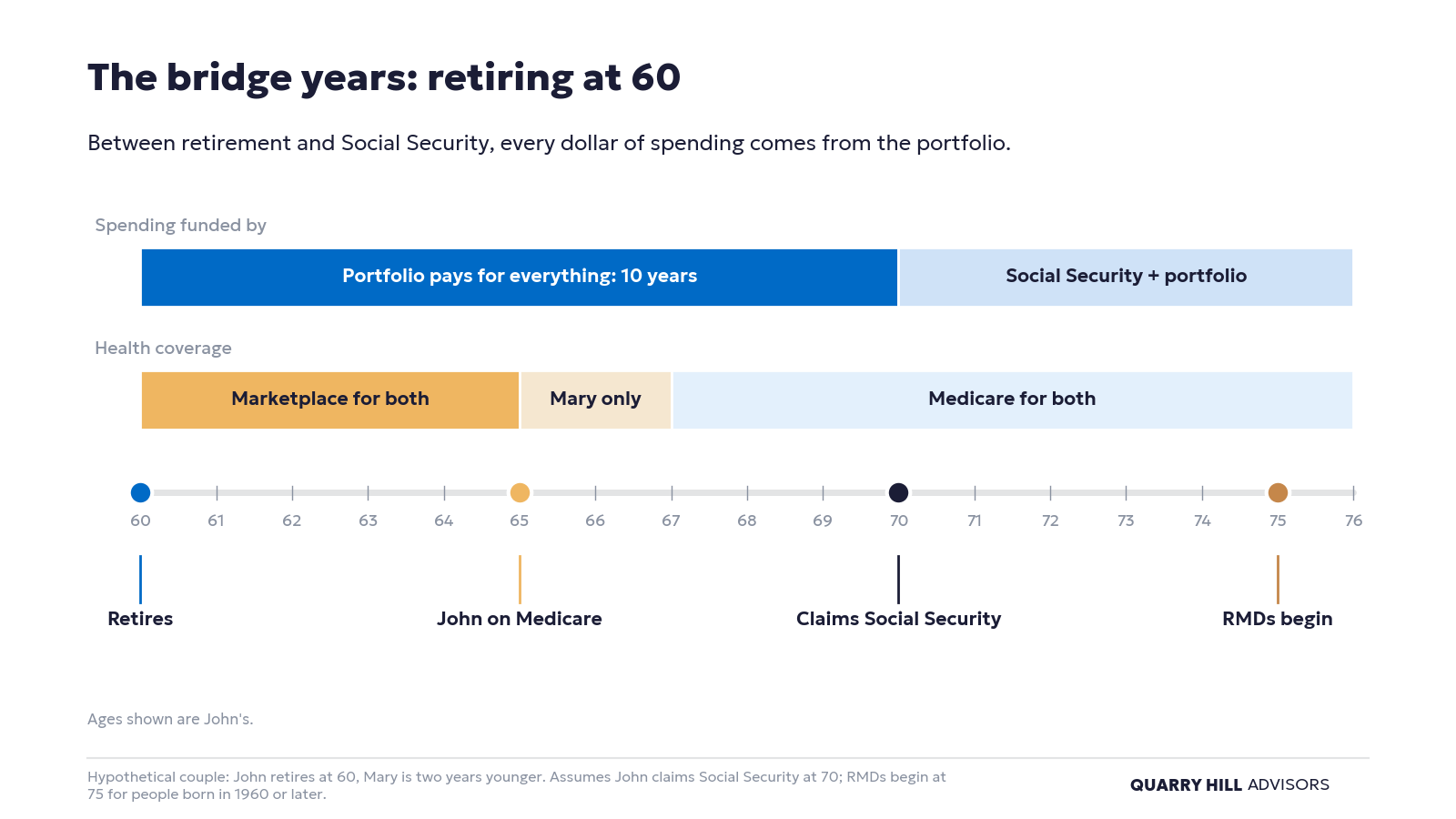
The second thing that gets missed is the stretch before Social Security. If John retires at 60 and waits until 70 to claim his maximum benefit, the portfolio funds every dollar of spending for a decade. If the market is down in the first two or three years of withdrawals, they’re selling shares at depressed prices to cover living expenses, and those shares are gone; they can’t participate in the recovery. The order of returns in the first several years of retirement can matter as much as the average return over the next thirty, and most people don’t feel that until they see it modeled.
Three expenses most retirement budgets underestimate
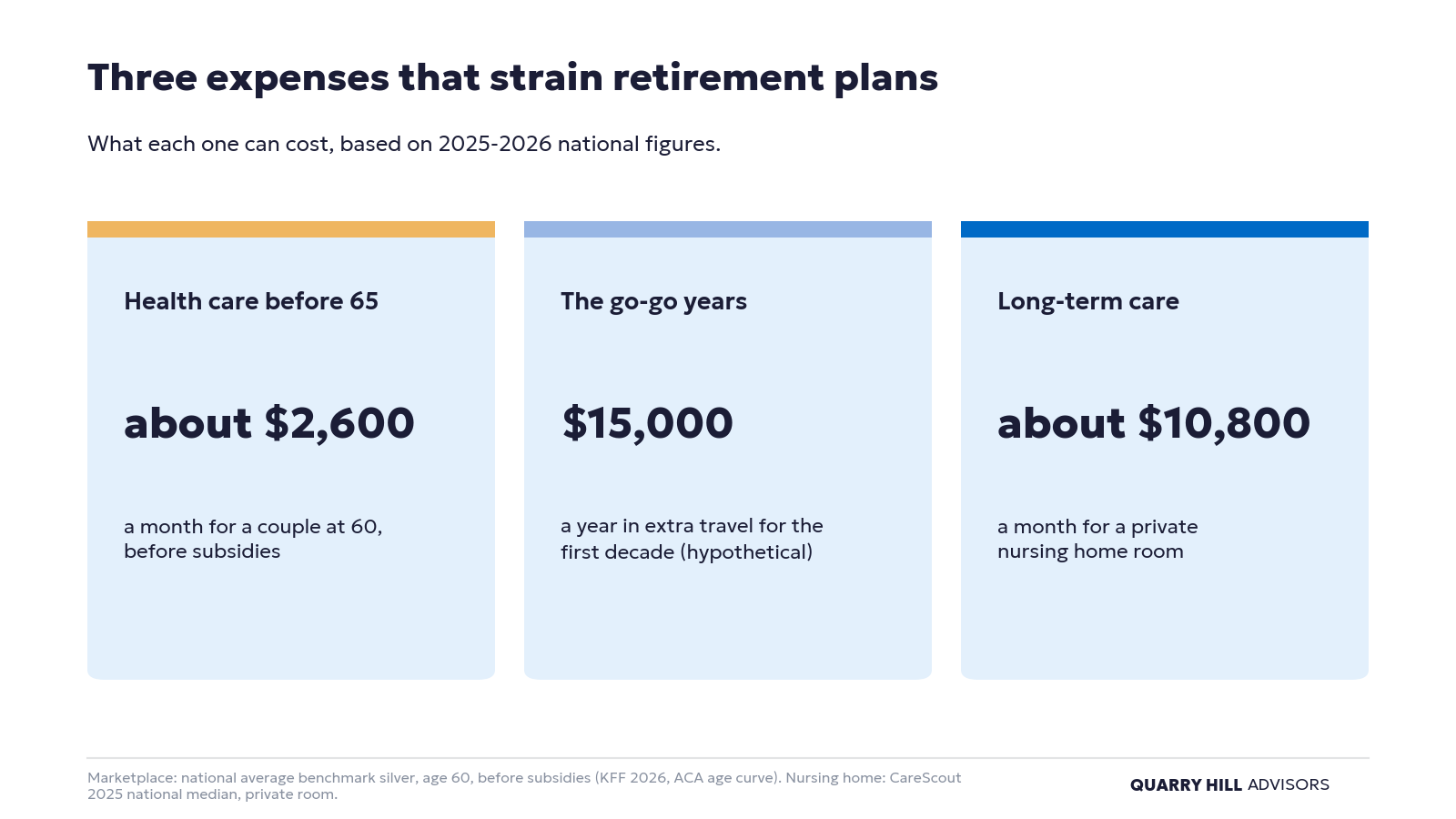
Three categories of expense trip up plans that look fine on paper.
Health care before 65. Retire at 60 and Medicare is five years away, so you need coverage on your own until then. Before subsidies, the national average benchmark silver plan on the marketplace works out to roughly $1,300 a month for a 60-year-old in 2026, or about $2,600 for a couple. The enhanced subsidies expired at the end of 2025, which brought back a hard cutoff: a household with income above 400% of the federal poverty level (about $84,600 for a couple) gets no premium tax credit at all, while income below that line can still qualify for real help. If you have a taxable brokerage account to live on and you manage your reported income carefully, staying under the line may be possible. It only works if you plan for it on purpose.
The go-go years. People tend to spend more in the first decade of retirement than at any other point, on travel, experiences, helping kids and grandkids, and home projects. Many assume their base monthly number covers it, and it usually doesn’t. Those extra dollars come out of the portfolio exactly when sequence risk is highest, so be deliberate about when and how you take them out.
Long-term care. I know this is one people would rather not think about. CareScout’s 2025 Cost of Care Survey put the national median for a private nursing home room at $355 a day, about $129,600 a year or roughly $10,800 a month. I’ve seen a single long-term care event permanently break a retirement plan that looked great on paper for 20 years. Insurance is one way to handle it, and there are others, but the plan has to handle it somehow.
What happens when you model real life
John and Mary want to retire when John turns 60, spend $10,000 a month after taxes, add about $15,000 a year in travel for the first decade, and bridge health care until Medicare. The plan also has to account for long-term care costs in their 80s.
A baseline plan with reasonable market assumptions can look pretty good. Then we layer in actual life: the health care gap, the higher early spending, some one-time expenses, and a more conservative return assumption, because this is planning and optimism doesn’t belong in the inputs. The plan that ended with $3 million now ends with $1.4 million. In a worse version, it runs short in their early 80s.
The right way to read that result is as information. It shows you where the plan is thin, and there are three dials you can actually turn.
Income. If John works to 61 instead of 60 and Mary works part-time for two years, the extra savings and the shorter withdrawal period together make a significant difference. One more year on both sides of the ledger, adding to the portfolio instead of drawing from it, can have an outsized effect on long-term plan success.
Spending. Pulling back from $10,000 a month to $8,000 is a $24,000 difference every year, and over 25 to 30 years that adds up. When we go line by line through what the spending is doing, many families find they can flex it without touching what they actually care about.
Allocation. The difference between a conservative allocation and a balanced growth allocation over a 30-year retirement is real. Sequence risk is also why I like keeping two to five years of essential expenses in cash or short-term bonds at the start of retirement. That buffer can keep you from selling stocks at the worst possible time.
The switch from saving to spending is the hard part
For most of the people we work with, the math is the easier half. They’ve spent 30 to 40 years in accumulation mode. Every month money goes in and the balance goes up, and that feels right. Then they flip the switch. Money comes out, the balance drops some months, and they’re supposed to be fine with that because the plan says so.
Temperament matters more than intelligence here. The people who find retirement genuinely scary are going through a real psychological transition, one their plan probably never addressed. In my experience, a clear sense of purpose and structure shapes how satisfied people are in retirement far more than their net worth does. That conversation rarely happens in a traditional planning meeting, and it should.
The families I see who feel most confident going into retirement don’t necessarily have the biggest portfolios. They’ve done the financial modeling and the personal work. They know what the money is for, and they’ve stress-tested the plan enough times to believe it holds.
Four steps to a retirement plan you can stick with
1. Map your income sources instead of your balance. Add up Social Security at different claiming ages, any pensions, and any part-time income you expect early on. Then work out what the portfolio has to produce to fill the gap. That gap number is what you build a withdrawal strategy around.
2. Model the expenses that actually worry you. Put in health care before Medicare, the travel you really want to do, and a long-term care scenario, even a rough one. Stress-test it with a year or two of bad returns at the start. If it survives all of that with a reasonable margin of safety, you have a plan.
3. Take Social Security timing seriously. For someone whose full retirement age is 67, waiting from 62 to 70 raises the monthly benefit by about 77%, from 70% of the full benefit to 124%. That’s a longevity hedge that’s hard to replicate with any other single decision. For many healthy people, especially married couples, the math of delaying is compelling, and it’s underused.
4. Build flexibility into your spending. A rigid $10,000 a month no matter what is fragile. Know your essential floor and your discretionary ceiling, and decide in advance which conditions would make you flex down and when you can flex up. The retirees I work with who feel most secure almost always have that kind of structure in place.
Frequently asked questions
Why are so many retirees going back to work?
For many it’s financial. In an AARP survey, 48% of retirees who returned to work said they needed the money or were worried about their financial outlook. The common gaps are the years before Social Security, health care costs before Medicare, higher spending early in retirement, and long-term care.
How much does health insurance cost if I retire before 65?
It depends heavily on age, location and income. Before subsidies, the national average benchmark silver plan in 2026 works out to roughly $1,300 a month for a 60-year-old. Households with income at or below 400% of the federal poverty level can qualify for premium tax credits; above that line in 2026 there is no subsidy.
When do required minimum distributions start?
Age 73 for people born from 1951 through 1959, and age 75 for people born in 1960 or later. RMDs apply to pre-tax accounts such as traditional 401(k)s and IRAs.
How much more do I get by waiting until 70 to claim Social Security?
If your full retirement age is 67, claiming at 62 pays 70% of your full benefit and claiming at 70 pays 124%, about 77% more per month. Delayed retirement credits stop at 70.
Quarry Hill Advisors is a Minnesota based Investment Advisory Firm registered with the Securities and Exchange Commission (SEC). Registration of an investment advisor does not imply a certain level of skill or training.