
You're 61 years old with $1.8 million saved. By every conventional
You've saved $2 million for retirement. By every measure, that should be more than enough. You're in the top 10% of savers, financial magazines call you wealthy, and online calculators say you're all set.
But that $2 million doesn't work the way you think it does.
If you don't understand the three factors that reduce your actual spending power, you could end up with 30-40% less usable income than you expected. Not because you made bad investment choices, but because of the mechanics built into the retirement system itself.
The Problem That is Often Overlooked
When you look at your portfolio and see $2 million, you naturally think about safe withdrawal rates. Maybe you've heard of the 4% rule: 4% of $2 million is $80,000 per year. Add Social Security, and you're thinking you'll have $100,000 to $120,000 in annual income.
That sounds comfortable. That sounds secure.
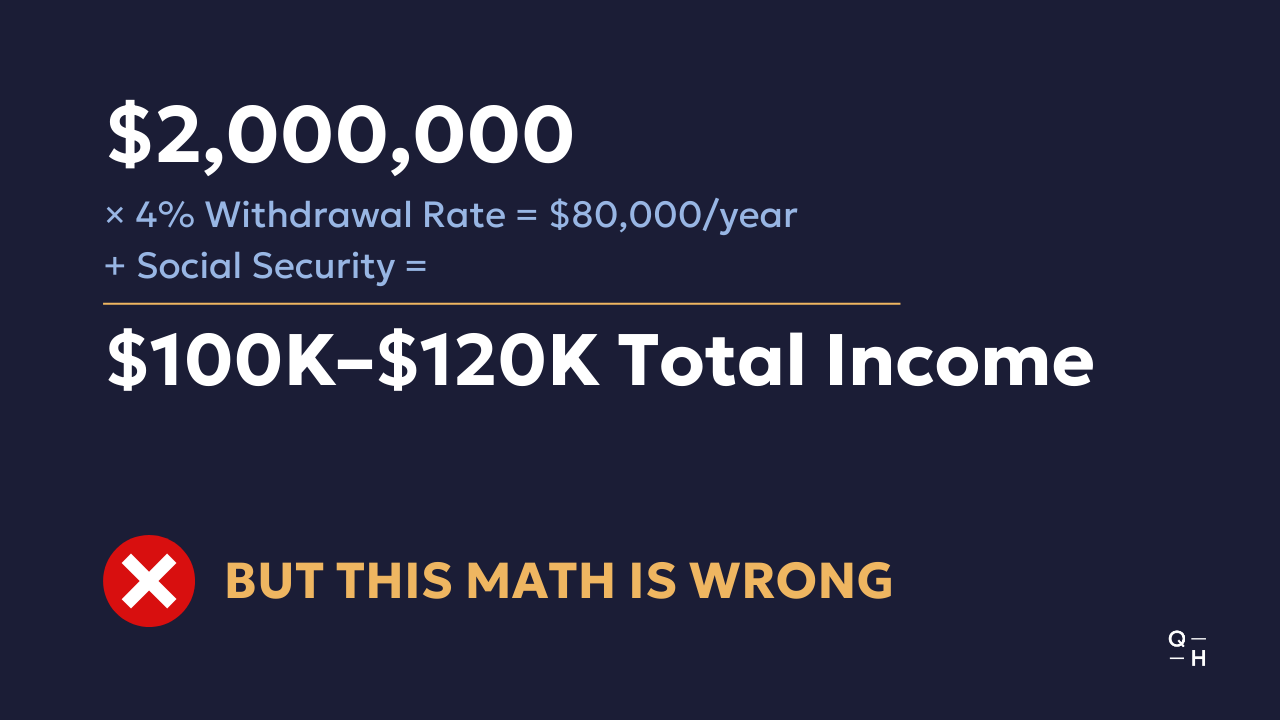
But it's missing three critical pieces of the puzzle.
First, that $2 million isn't sitting in one account type. Most successful people have their retirement savings spread across traditional 401(k)s, IRAs, Roth accounts, and taxable brokerage accounts, and every single dollar is taxed differently.
Second, the IRS has mandatory withdrawal requirements that kick in at age 73. Whether you need the money or not, these required minimum distributions can push you into higher tax brackets and create a cascade of unexpected costs.
Third, life events like losing a spouse don't just cut your household in half. They can trigger survivor penalties that dramatically reduce your actual spending power.
These aren't hypothetical problems. They're mathematical certainties built into the retirement system. And if you don't plan for them, you're going to be blindsided.
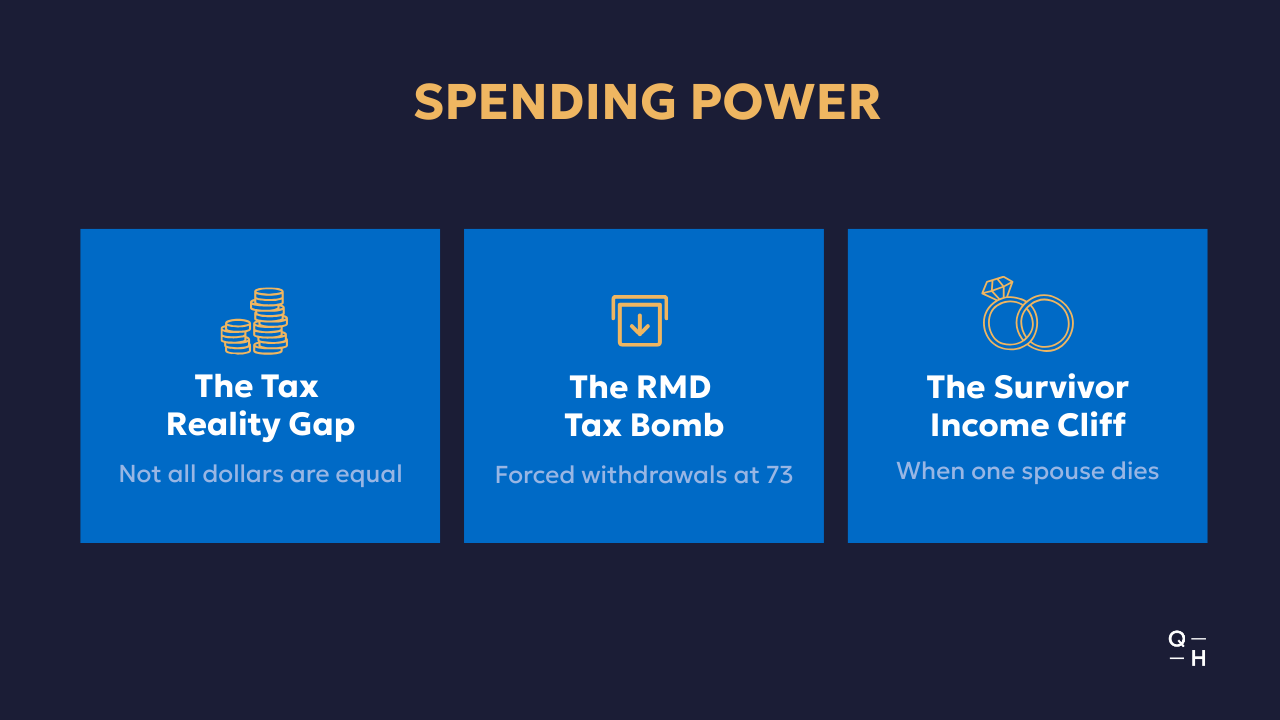
Let me walk you through the three factors that determine your real spending power in retirement…not the theoretical number, but the actual dollars you can confidently spend.
Factor #1: The Tax Reality Gap
The first factor is what I call "the tax reality gap." The second is "the RMD tax issue." And the third is "the survivor income cliff."
Understanding these three factors is the difference between a retirement that feels abundant and one that feels constrained, even with $2 million saved.
Your $2 Million Is Actually a Partnership with the IRS
Let's start with a typical scenario. You're 65 years old with $2 million saved, and here's how it's allocated:
- $1.2 million in traditional 401(k) and IRA accounts
- $400,000 in a taxable brokerage account
- $400,000 in a Roth IRA
Most people look at this and think, "I have $2 million."
But from a spending power perspective, you don't. You have a partnership with the IRS.
That $1.2 million in traditional retirement accounts? Every dollar you withdraw is taxed at ordinary income rates. If you're married filing jointly and withdraw $80,000 per year, that puts you solidly in the 22% federal tax bracket once you factor in other income sources.
But here's what people miss: it's not just 22% federal. You also have state income tax: 5.35% in Minnesota, for instance. So you're really looking at 27-28% in combined taxes.
The Real Math
Let's do the actual math:
You withdraw $80,000 from your traditional IRA. After federal and state taxes, you're left with about $58,000, not $80,000. And that's before we talk about Medicare premiums, which are income-based and can jump significantly at certain thresholds.
So when you look at that $1.2 million in traditional accounts and think "$48,000 per year using the 4% rule," you need to reduce that by 28%. Your actual spendable amount from that portion? About $34,500 per year.
Your $400,000 Roth IRA? That's truly yours. 4% is $16,000 per year, tax-free.
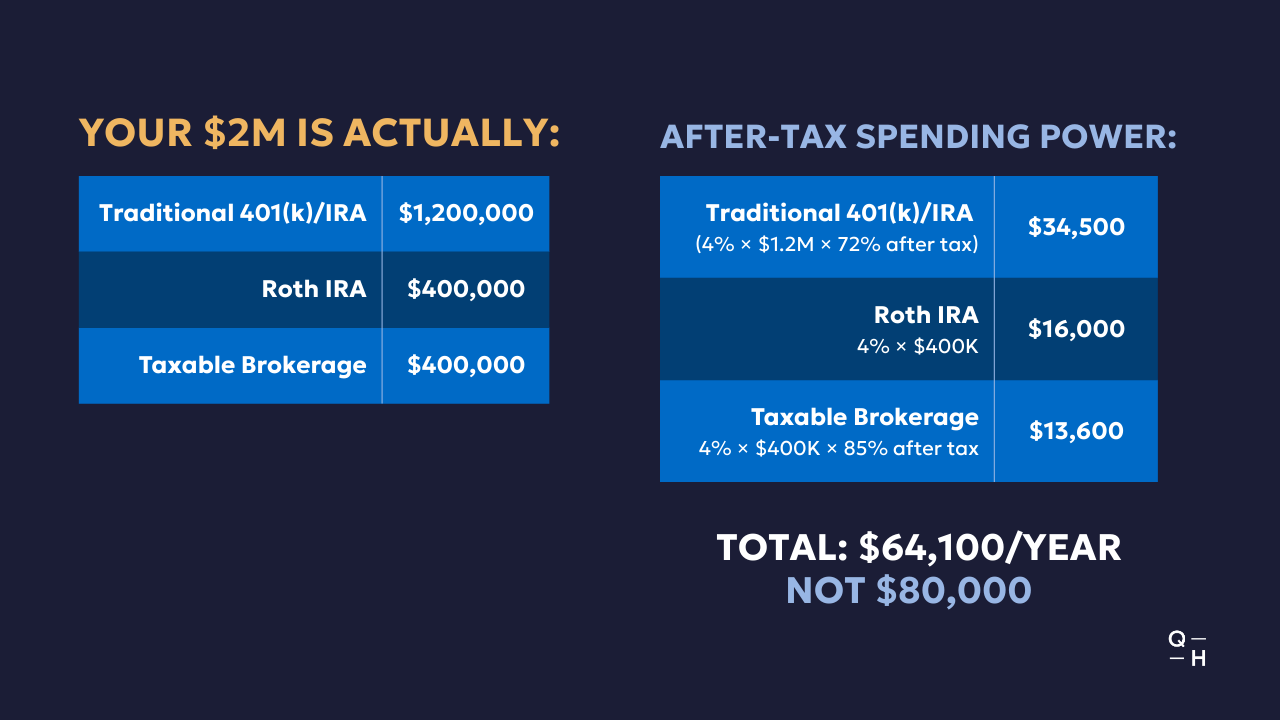
Your $400,000 in taxable accounts? That's mostly yours, but you'll pay taxes on dividends, interest, and capital gains as you sell. Let's estimate 15% effective tax on those withdrawals. 4% is $16,000; minus 15% leaves you with about $13,600.
Add it up: $34,500 + $16,000 + $13,600 = $64,100 per year.
Not $80,000. And definitely not the $100,000 to $120,000 people were imagining when they include Social Security.
This is the tax reality gap: the difference between the gross number and your actual spending power.
Factor #2: The RMD Tax Issue
Now let's talk about Required Minimum Distributions, because this is where things get really problematic for successful savers.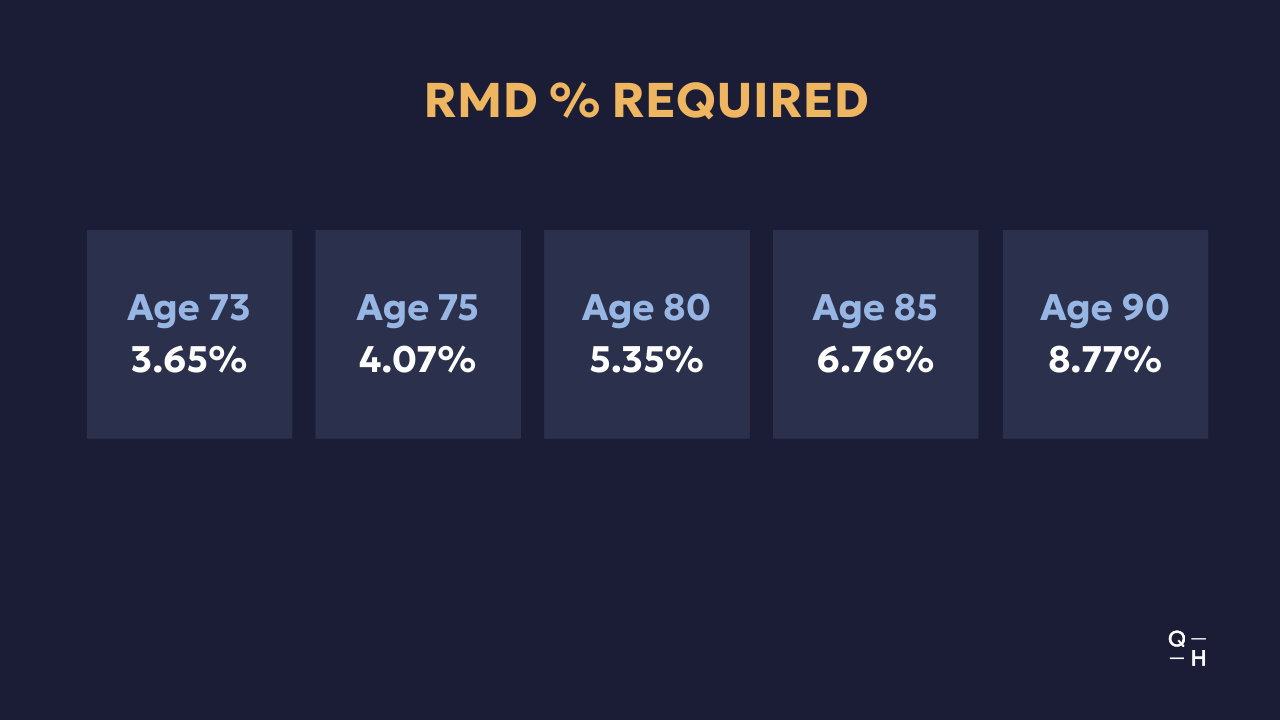
Starting at age 73, the IRS requires you to withdraw a percentage of your traditional IRA and 401(k) balances every year. In your first year, it's 3.65%. That percentage increases every single year as you age.
The stated reason is that the government gave you a tax break when you contributed that money, and now they want their tax revenue. Fair enough.
But here's the trap: these withdrawals happen whether you need the money or not. And they don't care about your other income sources.
How RMDs Create a Tax Cascade
Let's say you're 73 years old with that same $1.2 million in traditional accounts. Your first RMD? $43,800. And remember, this is taxable income on top of your Social Security and any other income.
But here's where it gets worse. If you've been a good saver and your investments have performed well, that $1.2 million might have grown to $1.5 million or $1.8 million by age 73. Now your RMDs are $55,000 or $65,000 per year, and they keep growing.
These mandatory withdrawals create what I call a tax cascade:
- The RMD pushes you into a higher tax bracket
- The higher income increases your Medicare Part B premiums (through IRMAA, Income-Related Monthly Adjustment Amount)
- Depending on your total income, it can make more of your Social Security taxable
A Real Example: Tom's Story
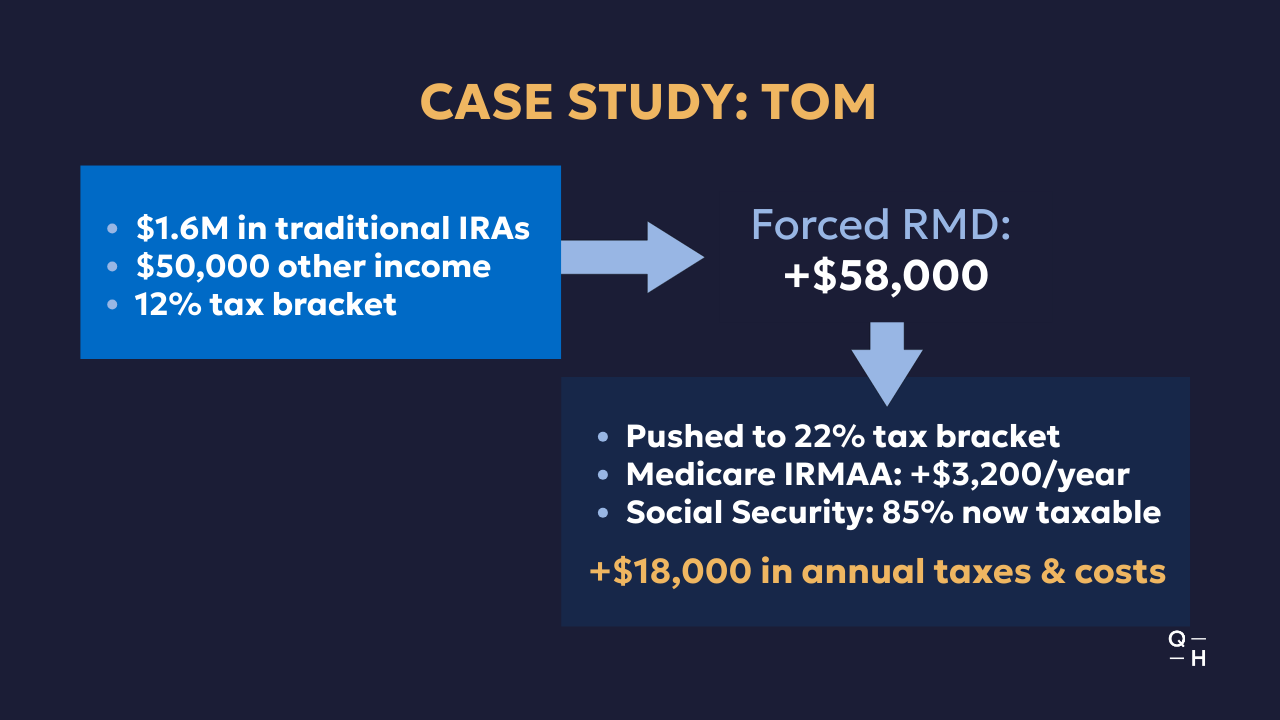
I had a client,let's call him Tom, who hit 73 with $1.6 million in traditional IRAs. He was already getting $50,000 per year from Social Security and pension income. His RMD added another $58,000 of taxable income.
This pushed him from the 12% tax bracket into the 22% tax bracket. It increased his Medicare premiums by $3,200 per year and triggered taxation on 85% of his Social Security instead of 50%.
The total impact? An additional $18,000 in annual taxes and Medicare costs. Money he didn't need to withdraw, creating taxes he didn't need to pay.
The time to address this problem is well before age 73. In those gap years between retirement and RMDs, your income is lower…and that's when you want to do strategic Roth conversions. Pay taxes at lower rates now to avoid the RMD tax bomb later.
But most people don't realize this until it's too late.
Factor #3: The Survivor Income Cliff
Now let's talk about the factor most people don't plan for: what happens when one spouse dies.
Most married couples think of their retirement as a joint plan. "We have $2 million. We have two Social Security checks. We're fine." But the math changes dramatically when you become a single-person household.
What Actually Happens
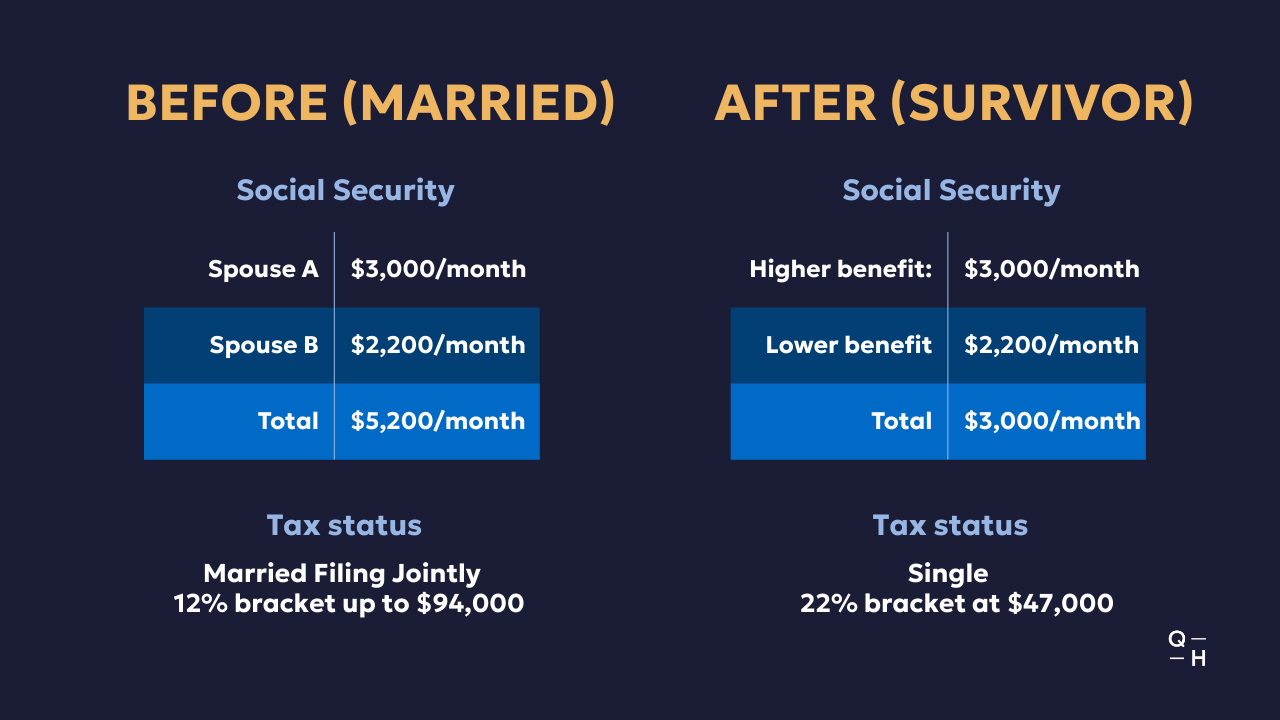
When one spouse dies, the surviving spouse keeps the higher of the two Social Security benefits and loses the lower one.
So if you were receiving $3,000 per month and your spouse was receiving $2,200 per month, you drop from $5,200 per month to $3,000 per month. You just lost $2,200 per month, or $26,400 per year.
And it's not just Social Security. Any pension income that doesn't have a 100% survivor benefit also drops or disappears entirely.
But here's the part that really hurts: your tax filing status changes from married filing jointly to single. And the tax brackets for single filers are roughly half the width of the brackets for married filing jointly.
The Brackets Tell the Story
In 2025, a married couple filing jointly stays in the 12% federal tax bracket up to about $94,000 of taxable income.
A single filer? You hit the 22% tax bracket at $47,000…compared to $94,000.
So suddenly, the surviving spouse is paying higher tax rates on less total income.
Robert and Linda's Story
Let me make this concrete with a real example.
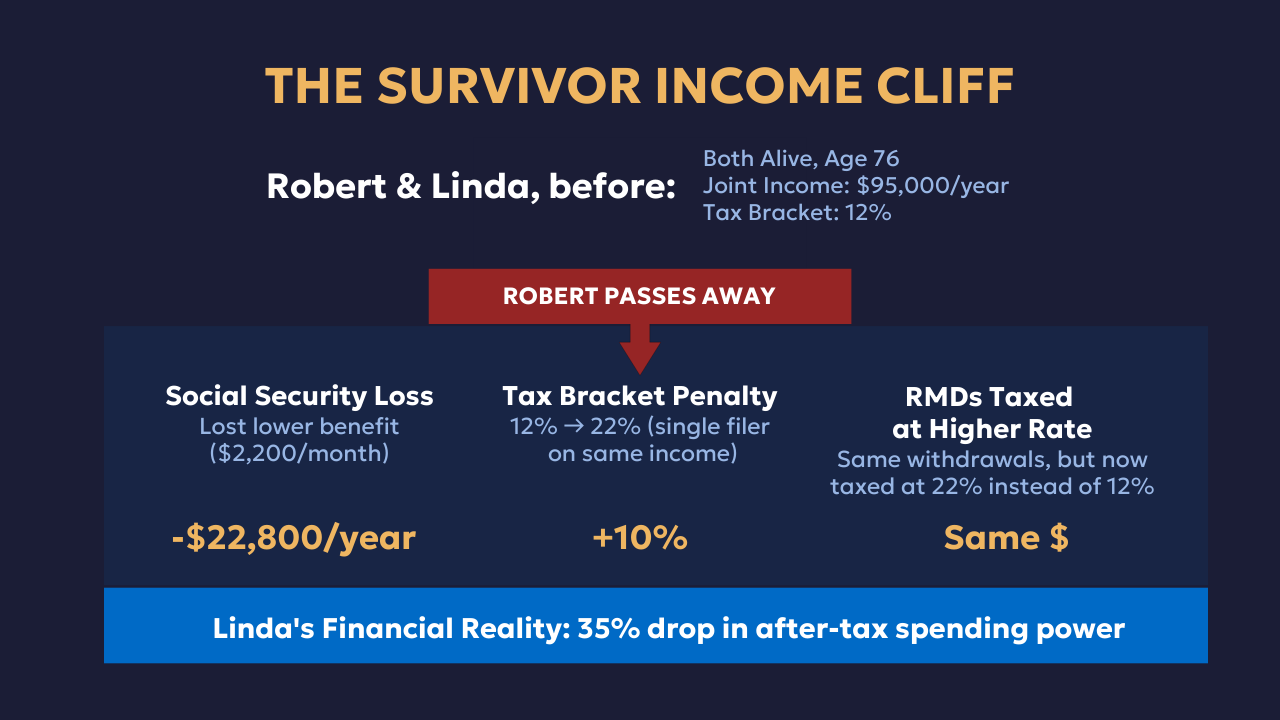
Robert and Linda had planned carefully. They had $1.8 million saved, both were getting Social Security, and their joint income in retirement was about $95,000 per year. They were comfortably in the 12% tax bracket.
But Robert passed away at age 76.
Linda kept his larger Social Security benefit of $2,800 per month and lost her benefit of $1,900 per month. She went from $56,400 in Social Security to only $33,600—a loss of $22,800 per year.
Her RMDs continued at the same dollar amount because they're based on the IRA balance, not household status. But now those RMDs were being taxed at 22% instead of 12% because of her single filing status.
The net result is Linda's after-tax spending power dropped by nearly 35%.
Not because she made any mistakes, but because the system is designed that way. That's the tax code.
The Three Factors Combined
So those are the three factors:
- The tax reality gap
- The RMD tax bomb
- The survivor income cliff
Each one independently reduces spending power. But combined, they can cut your effective income by 30-40% below what you expected.
The Solution: Structure, Not Savings
But here's the good news: when you understand these factors, you can plan for them. And in many cases, you can significantly reduce the impact.
The solution isn't to save more. The solution is to structure what you have more intelligently.
Here's what proper planning looks like when you have $2 million:
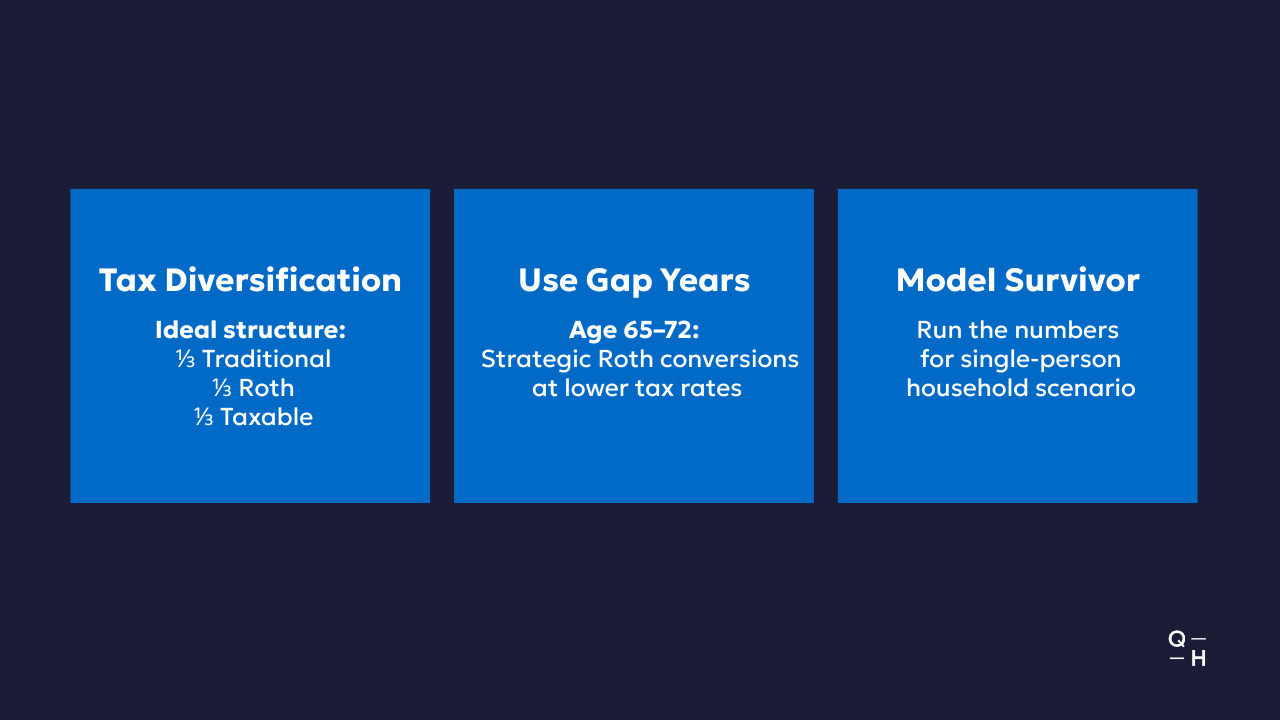
1. Create Tax Diversification Before Retirement
If most of your $2 million is in traditional accounts, you're setting yourself up for all three problems.
The ideal structure is roughly a third in traditional accounts, a third in Roth accounts, and a third in taxable accounts.
This gives you flexibility to manage your tax brackets in retirement. You can pull from different account types strategically to control your taxable income each year.
2. Use the Gap Years Strategically
Those years between retirement and age 73, when you don't have RMDs yet. That's your window.
If your income is lower during those years, that's when you systematically convert traditional IRA money to Roth. You pay taxes at 12% or 22% now to avoid paying at higher rates later when RMDs kick in.
3. Model the Survivor Scenario
Don't just plan for joint retirement. Run the numbers for what happens when one spouse passes away.
If the survivor's income is going to drop significantly, you need to account for that now. Maybe that means more life insurance. Maybe it means restructuring your assets. But you need to know the number before it happens, not after.
A Real Planning Example
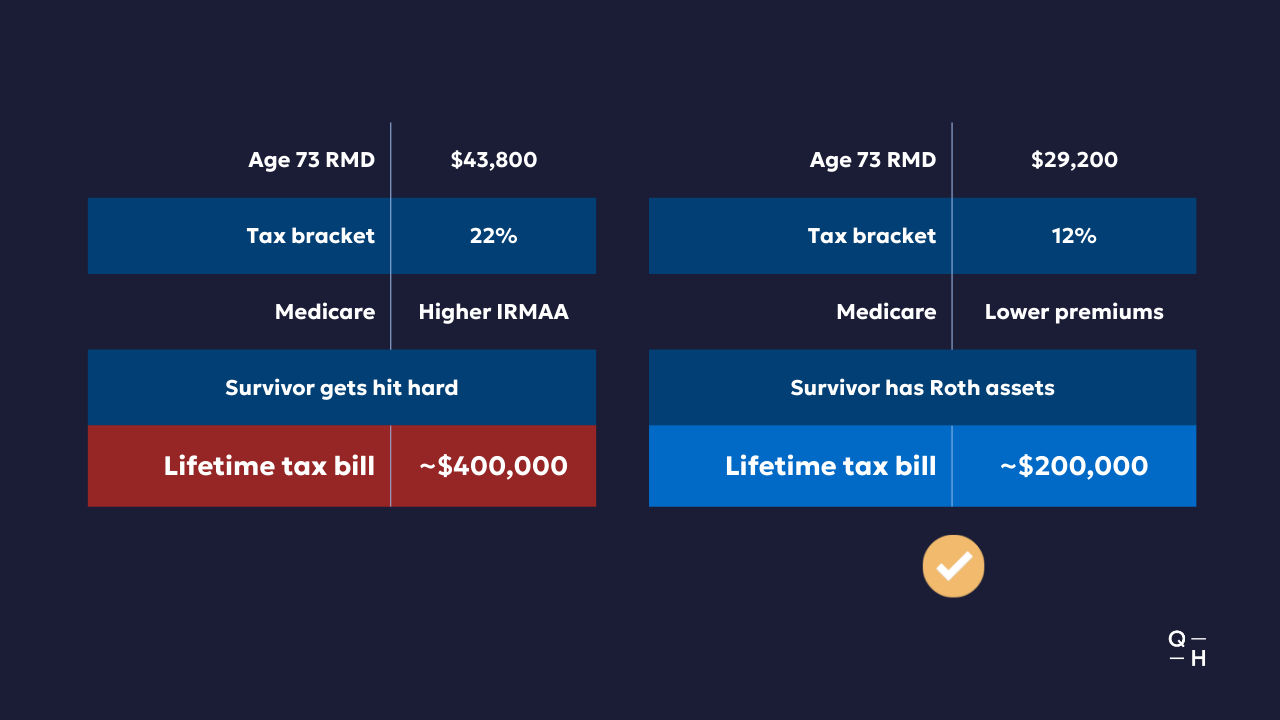
Let's go back to our couple with $2 million.
If they do strategic Roth conversions in their 60s and early 70s, they can move $400,000 to $600,000 from traditional to Roth accounts. They pay about $88,000 to $132,000 in taxes over that time period.
But by age 75, their RMDs are now based on $600,000 to $800,000 instead of $1.2 million. Their required withdrawals drop from $43,800 to $29,200.
They stay in a lower tax bracket. Medicare premiums stay lower. And when one spouse passes away, the survivor has more Roth assets to draw from tax-free.
The lifetime tax savings? Typically $150,000 to $250,000. Plus lower Medicare costs. Plus more financial security for the surviving spouse.
Your Real Retirement Number
Let me bring you back to where we started.
If you have $2 million saved for retirement, congratulations, you're in an excellent position. But that $2 million doesn't translate to $80,000 per year of spendable income. It just doesn't.
After accounting for the tax reality gap, planning around the RMD tax bomb, and preparing for the survivor income cliff, your actual sustainable spending is probably closer to $55,000 to $65,000 per year from your portfolio.
Add in Social Security and you're looking at $85,000 to $105,000 in total spendable income. That's still a very comfortable retirement, but it might not be what you expected when you first hit that $2 million milestone.
The difference between people who have a great retirement with $2 million and people who feel constrained isn't the amount saved. It's how well they structured those assets to minimize the impact of these three factors.
Next Steps
If you're approaching retirement with significant assets and want to understand your real spending power, not just the theoretical numbers, we can help.
At Quarry Hill Advisors, we specialize in helping professionals create tax-efficient retirement income strategies. We model out all three of these factors: your current tax situation, future RMD impacts, and survivor scenarios, so you know exactly what your retirement will look like.
Schedule a complimentary retirement readiness review to analyze your specific situation and discover opportunities to maximize your after-tax spending power.
Kyle Moore is a CERTIFIED FINANCIAL PLANNER™ professional and founder of Quarry Hill Advisors. Quarry Hill specializes in helping pre-retirees navigate the retirement transition with comprehensive, tax-efficient planning strategies.
-A note from Kyle Moore, CFP®
This material is intended for educational purposes only. You should always consult a financial, tax, or legal professional familiar with your unique circumstances before making any financial decisions. Nothing contained in the material constitutes a recommendation for purchase or sale of any security, investment advisory services or tax advice. The information and opinions expressed in the linked articles are from third parties, and while they are deemed reliable, we cannot guarantee their accuracy.